





Professional Business Plan Creation

Financial Modeling: Turn Your Numbers into Checks
Premium Advisory. Defensible Valuation. Maximum Credibility.
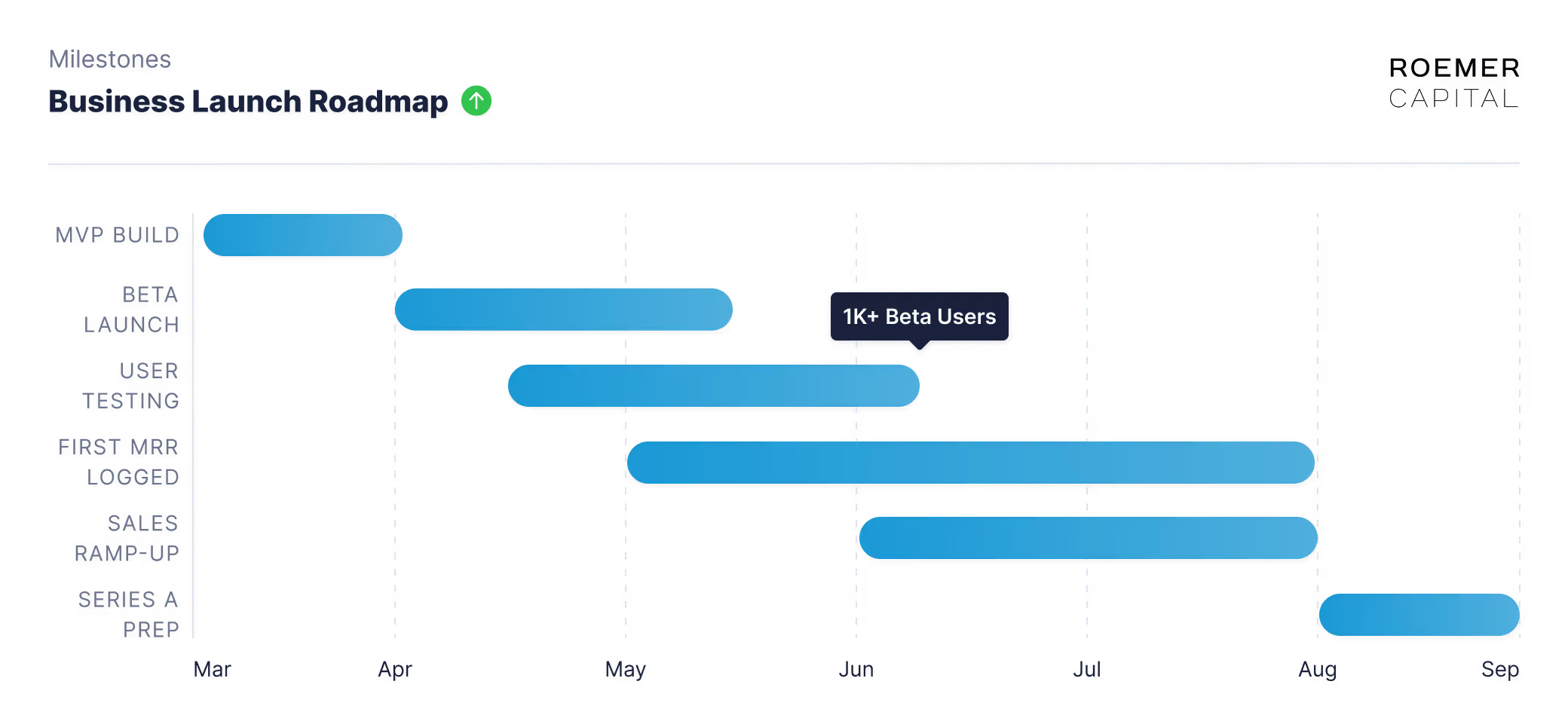

Working with top companies around the globe















The Reality: Investors don't invest in visions—they invest in resilient, validated models.
You lead an ambitious startup or a high-growth scale-up facing your next funding round. Many founders don't fail because of their product, but because of models that investors don't trust and valuations they can't explain.
Roemer Capital changes the narrative. We provide the strategic foundation that turns your data into deal commitments. We build models from the investor's perspective, not from a founder's wishful thinking.
Your Competitive Edge with Roemer Capital
Our business plans are designed to attract investors and guide your startup's growth. We focus on clarity and strategic insights to showcase your potential.
Logical Financial Models
We build simple, transparent structures with clear growth drivers—no complex "black box" solutions.
Defensible Valuation
We deliver a company valuation you can confidently represent and factually defend in any negotiation.
Zero Red Flags
By using realistic assumptions and clean Unit Economics, we eliminate the warning signals that usually kill deals early.
Operational Credibility
You enter meetings with documentation that proves you understand your business down to the deepest operational level.
End-to-End Support
We stand by your side from the initial data deep dive to the final strategic negotiation.
Company valuation
Why Many Startups Fail to Raise Capital
Investors spot immediately if revenue assumptions lack drivers or if Unit Economics fail to scale. A flawed model signals incompetence.

The 7-Step Process
We guide you through a precise process that guarantees transparency and quality.
Step 1: Initial Deep Dive
We evaluate your business concept and the current status quo of your financials.
Step 2: Defining Drivers
We identify the decisive levers for scaling your growth.
Step 3: Financial Modeling
Creation of a detailed, five-year financial model including comprehensive cash flow projections.
Step 4: Valuation Logic
Application of various methodologies to derive a realistic company valuation.
Step 5: Review Session
Collaborative walkthrough and strategic fine-tuning of all assumptions.
Step 6: Finalization
You receive a presentation-ready document, covering unit economics and scaling logic.
Step 7: Submission Support
We prepare you for investor Q&As and act as your ongoing partner for controlling and investor relations.
Roemer Capital Services
We offer holistic support that goes far beyond simple matchmaking.

Five-year financial models with clear growth drivers

Unit economics and detailed cash flow planning

Scenario analysis for various market developments

Multi-round and cap table logic for complex structures

Transparent valuation models based on market benchmarks

Executive Summary for the perfect first impression
The Reality: Investors don't invest in visions—they invest in resilient, validated models.
Cost: a monthly fee plus a success fee. The engagement runs on a monthly fee and a success fee that only falls due once the round has closed. Both numbers are on the table before the mandate starts and nothing gets added later. The monthly fee and the percentage are set out in writing in the offer before you sign. We publish no price list, because the fee follows scope and round size.
Customer testimonials
Transformative support for our startup journey.
I worked with Roemer Capital to professionally set up the financial structure and planning of my business with a solid financial plan – and I’m completely convinced. The entire process was marked by clarity, structure, and entrepreneurial thinking. Instead of superficial advice, I received well-founded strategies, clear action recommendations, and a robust financial model geared toward growth and scalability.

Get in Touch

FAQs
Still have questions? Book a meeting and let's talk.
How much starting capital do you need to start a business?
Capital requirements depend heavily on the business model. In the tech sector, such as SaaS platforms or deep tech, starting capital requirements between 250,000 euros and several million euros are the norm to secure product development, market entry, and runway.
How do you write a good business plan?
A modern business plan is not a classic text document, but a strategic decision-making tool. The crucial element is a robust financial model in Excel that maps the economic logic of your company, while the text serves merely to provide context.
How many pages should a good business plan have?
An investor-relevant business plan consists primarily of a financial model and not pages of text. Essential components are the profit and loss statement, the balance sheet, the cash flow statement, the cap table, and a sound company valuation.
How long does it take to write a business plan?
Creation usually takes one to three months. The timeframe depends on the complexity of the data availability, the maturity level of your business model, and the necessary depth of the financial model.
How can I get a business plan created?
The first step is an initial consultation at Roemer Capital. In this session, our experts check if and how we can support your project and clarify the capacities for professional implementation.
Who can write a business plan for me?
You should entrust the creation to experts with capital market experience. AI-based tools often produce content and numbers without logical depth, whereas at Roemer Capital we act as financial strategists & business plan experts who speak your language and that of the investors.
Is a business plan mandatory?
Yes, a professional business plan is mandatory for applying for loans, grants like the founding grant, as well as for acquiring investor capital and growth capital.
Can ChatGPT write a business plan?
No, because ChatGPT cannot perform strategic plausibility checks. AI tools tend to make errors in logical connections and financial models, which immediately destroys credibility with investors.
Why is a business plan important for an entrepreneur?
It serves as a strategic roadmap for management and as an essential communication tool for capital providers. A good plan shows that you fully understand your business model and financial dependencies.
What are the three Cs for a successful business plan?
The decisive factors are Capital (precision in capital requirements), Clarity (strategic clarity), and Credibility (trustworthiness through sound analyses).
What is a 7-step business plan?
This is our structured process that leads you from the initial analysis through driver definition and financial modeling to final support in the search for investors.
What are the 5 main goals of a business plan?
The main goals are capital acquisition, strategic clarity, risk assessment, resource planning, and the analytical plausibility check of the entire project.
How do you set up the financial part if there are no real numbers yet?
The financial part is modeled based on robust assumptions. We use market data, benchmarks, and expert knowledge to create a realistic plan that withstands various scenarios.
Which business plan templates should one use?
Generic templates are dangerous because they do not map the individual logic of your company. Investors recognize standard templates immediately, which questions your excellence and professionalism.
Which assumptions are realistic and how do you justify them?
Realistic assumptions are based on primary research, industry benchmarks, and historical market data. Every number must be derived and justifiably explainable to third parties.
Is a business plan necessary at all, especially for very small projects?
Yes, because it serves as an internal control tool. Even small projects benefit massively from the strategic discipline and risk assessment that written planning requires.
Do I need a classic business plan or is a simplified Lean Plan sufficient?
For external capital providers like banks and investors, a classic business plan including a detailed financial model is mandatory. A Lean Plan serves merely for early internal validation.
How do I define my target audience and revenue?
We use a bottom-up analysis where we infer revenue from operational drivers like marketing spend and conversion rates. The target audience is analytically defined via market segments and purchasing power.
How do I describe competitors and market opportunities?
A detailed competitor matrix and a SWOT analysis show your differentiation. You must prove why your company will gain market share and what barriers competitors have.
How often must I update my business plan?
A business plan is a living document. It should be continuously adjusted as soon as new insights from the market or operational data are available, but at least once per quarter.
What are the typical mistakes when writing a business plan?
The biggest mistakes are a lack of focus, implausible numbers without liquidity logic, copying content, and a missing company valuation. Liquidity decides survival, not revenue.
What role does the Business Model Canvas play compared to a classic business plan?
The Business Model Canvas is an internal thinking tool for strategy finding but not an investor-relevant document. It does not replace the necessary depth and financial planning of a classic business plan.