





Sell Your Company

Sell Your Business: Confidential, Prepared, with Several Buyers
Want to sell your company, in full or in part? Roemer Capital guides founders and shareholders of technology and growth companies with running revenue through the whole sale: valuation, confidential buyer search, negotiation and closing. A sale usually takes 6 to 12 months. You pay a fixed monthly amount plus a success fee that is only due on a sale.

Working with top companies around the globe















Is your company ready to be sold?
Buyers pay for a company that keeps running without you. That means reliable figures, recurring revenue, an orderly cap table and contracts that survive a change of owner. The earlier you check these points, the more room you have on price and timing. Our exit checklist shows you where you stand today.
Reasons to sell a company
Many sales start with an enquiry: a competitor or a larger group wants to acquire your company. Others start because founders want to step back, because investors expect an exit after some years or because a strong partner can accelerate growth. A succession with no successor in the family or the team is another common reason. Plan the sale before one of these reasons puts you under time pressure.

Buyers for Your Company: Strategic, Financial or Management
The right buyer determines the price, the structure and your role after the sale. We approach the suitable buyer groups in parallel and in confidence. That way you can compare offers instead of accepting the first one. Your name is only disclosed once an interested party has signed a non-disclosure agreement.
Strategic Buyers
Companies from your industry or adjacent markets. They pay for technology, customers and synergies and often acquire all shares.
Financial Investors
Private equity firms and family offices. They often buy a majority and keep you invested with a stake to develop the company together.
Management and Succession
In a management buy-out your leadership team takes over, in a management buy-in an external manager. This is usually financed with equity, bank loans and a vendor loan.
What We Handle When You Sell Your Company
We run the sale from the first valuation to closing. Our processes are modelled on the DIN EN ISO 9001 standard, and you can see the status at any time in our client portal, Roemer Capital OS. Tax and legal questions are handled by your tax adviser and your law firm, and we coordinate with both.

Determine the Company Value
We set a reasoned value range using revenue and EBITDA multiples and comparable transactions. You go into talks with a realistic price expectation.

Sale Documents
We prepare an anonymous short profile (teaser) for the first approach and an information memorandum with business model, figures and plan for interested parties who have signed a non-disclosure agreement.
Confidential Buyer Search
A longlist of suitable buyers becomes a shortlist. We approach strategic buyers, financial investors and family offices confidentially and keep competition between them alive.

Data Room and Due Diligence
We set up the data room to our standard and handle buyer questions during due diligence, the in-depth review before the purchase.
Purchase Price and Contract
We negotiate the letter of intent (LOI), purchase price and structure, such as share deal or asset deal, earn-out and reinvestment, and support signing and closing. Your law firm drafts the purchase agreement.
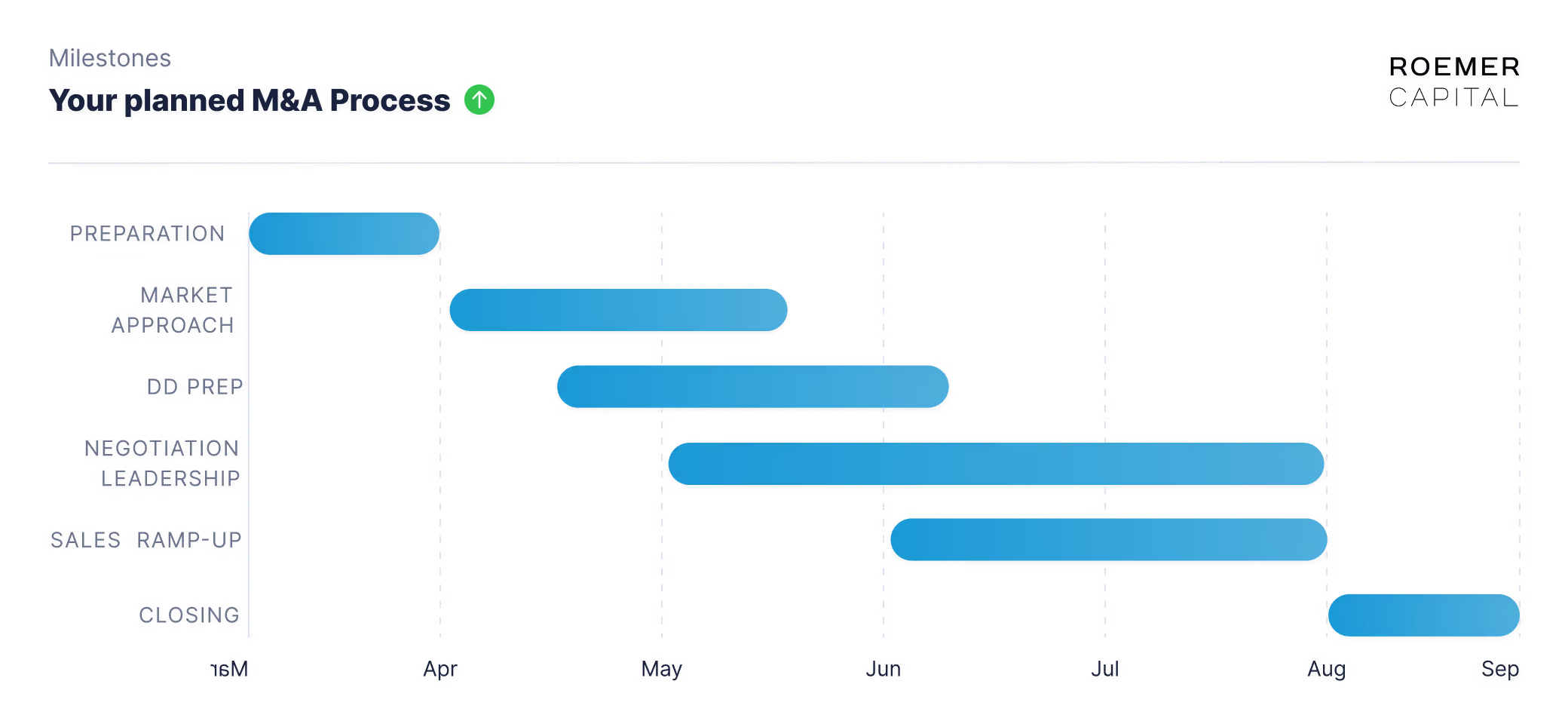
Selling a Company in Three Phases and 6 to 12 Months
Preparation
Confidential first call, readiness check, value range, short profile, information memorandum and data room.
Marketing
Confidential approach to the buyers on the shortlist, non-disclosure agreements, management meetings and first offers.
Completion
Letter of intent, due diligence, purchase agreement, signing and closing, until the purchase price is in your account.
With us you pay a fixed monthly amount and a success fee that is only due on a sale and depends on the purchase price achieved. Both amounts are in the written offer before the mandate starts. On top come the costs of your law firm and your tax adviser and, when selling shares in a German GmbH, the notary fees.
FAQs
Still have questions? Book a meeting and let's talk.
How do I sell my company?
With a structured process in three phases: preparation with valuation and documents, confidential outreach to several suitable buyers, and negotiation through to closing. What matters most is having several interested parties at the same time. If you talk to only one buyer, you negotiate without an alternative.
What is my company worth?
A valuation shows this, using multiples of revenue or EBITDA, meaning earnings before interest, tax, depreciation and amortisation, and comparable transactions. For technology companies, growth, recurring revenue and customer retention weigh heavily. The result is a range. In the end, competition between buyers sets the price.
How long does it take to sell a company?
Usually 6 to 12 months from the start of the mandate to closing. Preparation takes a few weeks; buyer search and due diligence take up most of the time. Clean figures and a complete data room shorten every step.
How much does it cost to sell a company?
With us, a fixed monthly amount plus a success fee that is only due on a sale and depends on the purchase price achieved. Law firm, tax adviser and, for shares in a German GmbH, the notary come on top. We do not bill by the hour and publish no price list.
What is the difference between a share deal and an asset deal?
In a share deal the buyer acquires the shares in your company and with them the whole business, including all contracts, rights and obligations. In an asset deal the buyer purchases individual assets such as technology, customer contracts and brand, and the company stays with you. Sellers usually prefer a share deal, buyers often an asset deal because it limits liability risks.
Do I have to stay with the company after the sale?
Often for a transition period, so that customers, team and know-how transfer safely. How long is a matter of negotiation. With an earn-out, part of the price depends on results after the sale, and you usually stay on longer. Financial investors often expect you to keep a stake.
How does the sale stay confidential?
Buyers first see only an anonymous short profile, the teaser, without the company name. Only after a non-disclosure agreement do they receive the name, the information memorandum and access to the data room. Employees, customers and competitors learn about the sale only when you decide.
Which documents do I need for the sale?
Annual accounts and management accounts for the last three years, a business plan, revenue and customer metrics, the cap table, key contracts with customers, suppliers and employees, and documents on IP and software. At the start we tell you what is missing and build the data room from it.
What happens to my employees when I sell?
In a share deal your company remains the employer and employment contracts continue unchanged. In an asset deal under German law, employment relationships transfer to the buyer under Section 613a of the German Civil Code (BGB) when a business or part of it is transferred. The employees concerned must be informed in text form before the transfer.
How are the sale proceeds taxed?
In Germany it depends on how you hold the shares. If you hold shares in a GmbH privately with a stake of at least 1%, 60% of the gain is taxable under the partial income method (Sections 17 and 3 No. 40 of the Income Tax Act). If your own holding GmbH holds the shares, the gain is effectively 95% tax-exempt (Section 8b of the Corporate Income Tax Act). Clarify the structure early with your tax adviser; we do not provide tax advice.
Where do I find a buyer for my company?
Business-for-sale platforms mainly reach smaller businesses. For technology and growth companies, the route usually leads through targeted, confidential outreach to strategic buyers and financial investors. Our network includes more than 1,000 contacts at more than 400 investor firms.
Who is Roemer Capital?
Roemer Capital GmbH is an independent fundraising and M&A advisory boutique based in Düsseldorf, Germany. It advises technology companies with a product in the market and running revenue on funding rounds from EUR 1 million (Series A to C), company sales and as a fractional CFO. Lucas E. Roemer, author of the book "Kapital folgt Struktur", founded the company in July 2023. It is not connected to companies with the same or similar names in other countries.