Capital Acquisition for Companies: Which Financing Routes Really Count for DACH Scaleups


Whether you're refining your pitch, planning your fundraising strategy, or scaling your business: we're here to help.






Capital acquisition is not one decision, but a modular kit
When scaleups talk about capital acquisition, they often mean “we need a round”. In practice, that is too narrow. You are not only deciding how much money to raise. You are deciding which mix of equity, debt and hybrid instruments fits your stage, your margin and your exit horizon.
For revenue-generating companies from pre-Series A to exit, the rule is: the clearer your traction and cash flow, the more options you have. The less clear the numbers, the more expensive and dilutive every solution becomes. That is why good capital acquisition starts with structure, not with the first term sheet.
Equity: expensive in ownership, strong on risk
Equity gives you room for investments that banks do not want to carry: product development, market entry, longer payback periods. The price is dilution and governance. Investors expect transparency, reporting and often influence on strategic decisions.
When equity makes particular sense:
- You are scaling into markets with high uncertainty and need a buffer.
- Your working capital is rising faster than your operating cash flow.
- You want to build a clear investor story for follow-on financing or an exit.
When you should be careful: when you use equity to close operational bottlenecks that are really a liquidity and process problem. Then you pay too much in the long run for a short-term symptom.
Debt: bank-related and loan-like
Debt does not dilute, but it comes with interest and repayment. For scaleups with predictable revenue, overdraft facilities, investment loans or growth-oriented credit lines can be a strong instrument.
Banks and credit partners mainly examine:
- historical and planned cash flows,
- equity ratio and collateral,
- the quality of your reporting,
- the purpose of the funds and your ability to repay.
Debt works well when unit economics hold up and you are pre-financing peaks or investments. It works poorly as a permanent substitute for missing profitability. Plan stress scenarios: what happens to repayments and covenants if revenue is weaker for two quarters?
Venture capital: growth capital with a clear equity logic
Venture capital remains relevant if you want to scale aggressively and need capital beyond classic bank financing to do so. VCs look for scalable models, strong traction and a credible upside.
For DACH scaleups, this means in concrete terms: narrative and numbers have to match. CAC, payback, gross margin, retention and cash runway belong on the table before you polish pitch decks. The process is more intensive than many expect: data room, commercial diligence, cap table and governance are examined early.
VC is not the standard route for every profitable niche model. If your growth is solid but not hyper-scalable, other instruments may fit better.
Private equity: when substance and cash flow count
Private equity comes closer as soon as revenue and processes are more resilient. Growth and buyout investors pay closer attention to sustainable value creation, management quality and exit readiness.
For you as a scaleup, PE can mean:
- growth capital with clear value creation plans,
- a partial exit for founders,
- or the start of a structured sale process.
Expectations are high: reporting, compliance and forecast quality have to meet investor standards. If you are aiming for PE, work on governance and clean numbers early.
Mezzanine and hybrid structures
Mezzanine capital sits between equity and debt. It is often subordinated and more expensive than a classic loan, but more flexible and less dilutive than pure equity. Typical forms are subordinated loans, silent partnerships or convertible instruments.
Mezzanine can be a bridge if:
- bank lines are exhausted,
- the timing is not yet right for a full equity round,
- you have predictable cash flow and can show a clear use of funds.
Pay attention to total costs, covenants and exit clauses. Hybrid instruments look elegant, but become expensive if the assumptions are too optimistic.
Public funding and crowdfunding: useful, but rarely enough on their own
Public grants, guarantees and subsidized loan programs can improve the capital structure, especially in combination with bank financing. The effort for applications, evidence and reporting is real. Plan time and capacity for it.
Crowdfunding can work for brand building and community, but it is rarely the main financing for complex scaleup growth. Use it selectively, not as a substitute for a solid investor or bank process.
A brief note on token and blockchain financing
Token-based models keep coming up in pitches. For most DACH scaleups with a classic product and sales model, they remain a side path. Roemer Capital focuses on classic growth financing and the investor process: equity, debt, mezzanine, public funding and preparation for a fundraise or M&A.
How to approach capital acquisition in practice
- Clarify the need: How much cash do you need, for what period and for what purpose?
- Match the instruments: What carries risk (equity), what is carried by cash flow (debt), what bridges the gap (mezzanine)?
- Build the numbers: Get the P&L, cash flow, balance sheet and scenarios investor-ready.
- Orchestrate the process: Prioritize target investors and banks, set a timeline, sharpen the narrative.
- Negotiate with the full picture: Not only valuation or interest rate, but dilution, covenants, governance and follow-on rounds.
Good capital acquisition does not just improve your bank balance. It improves your liquidity, your negotiating position and your strategic options for the next 18 to 36 months.
Common mistakes in capital acquisition
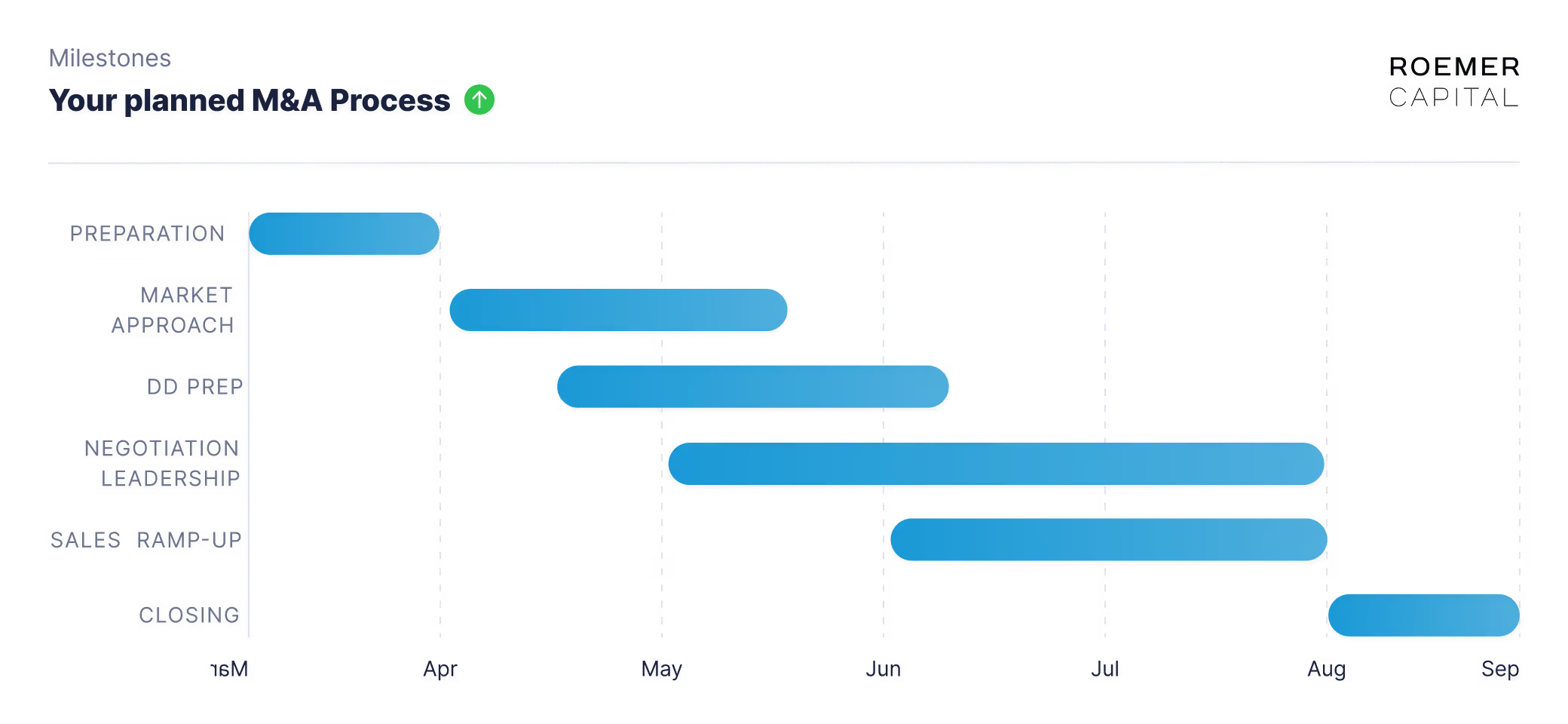
The most expensive mistake is starting too late. Good processes take weeks to months: numbers, narrative, longlist, first meetings, diligence. If you only act under acute cash pressure, you negotiate from a defensive position.
Other typical mistakes:
- mixing instruments without understanding total costs and covenants,
- too many parallel conversations without prioritization or process management,
- maximizing valuation while overlooking governance traps,
- treating public funding as “nice to have” and missing the timing,
- underestimating internal capacity: fundraising eats up management attention.
The remedy: clear roles in the team, a well-managed data room and a realistic weekly plan. Capital acquisition is a project with milestones, not a side job between product and sales.
What investors and banks in DACH look at most closely
Regardless of the instrument, the same checkpoints keep coming up: solid traction, comprehensible unit economics, the quality of the forecast and the team's ability to explain deviations from plan early. Add to that legal cleanliness, the cap table and customer concentration.
If you are scaling internationally, expect additional questions about market structure, regulation and local go-to-market logic. The more clearly you prepare these topics, the shorter the diligence and the stronger your negotiating position.
Conclusion
There is no “one” financing. There is the right mix for your risk, your margin and your horizon. If you understand the instruments and run the process cleanly, you raise capital on better terms and with less chaos in day-to-day business.
At Roemer Capital, we support scaleups with fundraising and M&A: from capital structure and investor access to transaction preparation. If you want to sort out your next financing options, let's talk.
Book a strategy call on fundraising and M&A
FAQs
Here you can find the important questions.