M&A Process: The Phases of Selling a Company

Whether you're refining your pitch, planning your fundraising strategy, or scaling your business: we're here to help.






- An M&A process has twelve phases, from preparation through teaser, NDA and information memorandum to signing and closing.
- From preparation to closing it usually takes 6 to 12 months, and due diligence alone often takes six to twelve weeks.
- The teaser is short and anonymous, the information memorandum is detailed and only available after an NDA.
- Indicative offers are non-binding, and both sides are only legally bound at signing.
- Compare offers by payment at closing, earn-out, escrow and risk, not just by enterprise value.
An M&A process for selling a company runs in three stages: preparation, marketing with two rounds of offers, and completion with the purchase agreement, signing and closing. Within those stages sit twelve phases, from the teaser and the information memorandum through due diligence to the transfer of the shares. From the start of preparation to closing, it usually takes 6 to 12 months.
This guide walks through each phase, gives a sample timetable and shows with numbers why the offer with the highest headline figure is not always the best one. The teaser and the information memorandum get their own section, because they decide how the first round goes.
What is an M&A process?
M&A stands for mergers and acquisitions. When a company is sold, the M&A process usually means a structured auction. The sell side approaches several potential buyers at the same time, and they submit offers in two rounds on a fixed timetable. Competition is meant to improve price and terms and to make it more likely that the deal actually closes.
In Germany there are no statutory rules for this, unlike public procurement. The sell side sets the rules in a process letter: deadlines, what the offers must contain, contact persons, and rules for the data room and questions. In the early phases, the non-disclosure agreements are the main legally binding documents.
There are three variants:
- Broad auction: several dozen potential buyers. Wide market coverage, but a lot of work and a higher risk that the sale becomes known.
- Limited auction: a carefully selected group, in practice often 10 to 30 addresses. This is a common format for mid-sized companies.
- Exclusive negotiation: one buyer only. Discreet and fast, but without a market comparison.
What are the phases of an M&A process?
- Preparation: equity story, financial model, adjusted figures, data room, and a check of shareholding structure and consents.
- Valuation: a realistic value range and a decision on which buyer groups to target.
- Longlist and shortlist: collect every possible buyer, then pick the ones you will actually approach.
- Teaser: an anonymous short profile for the first approach.
- NDA: a non-disclosure agreement with every party that wants to go further.
- Information memorandum: the detailed company description, sent together with the process letter.
- Indicative offers: non-binding first price indications, followed by the selection for round two.
- Due diligence with data room: management presentations, the bidders' review, questions and answers.
- Binding offer or LOI: price, marked-up purchase agreement, proof of funding and, where agreed, exclusivity.
- SPA negotiation: the share purchase agreement with price mechanism, warranties and closing conditions.
- Signing: conclusion of the agreement, which for shares in a German GmbH means notarisation.
- Closing: the conditions are met, the price is paid and the shares pass to the buyer.
How long does an M&A process take?
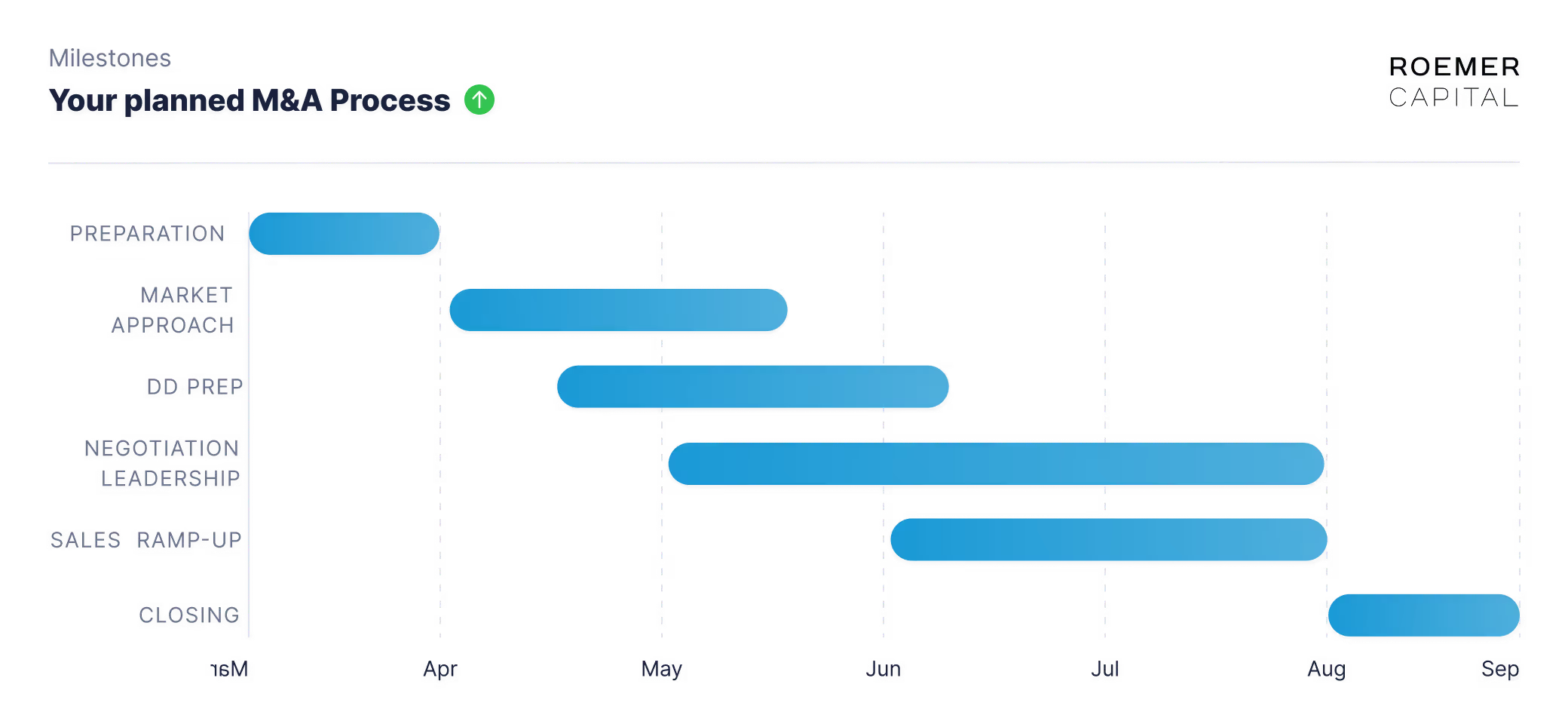
Usually 6 to 12 months from preparation to closing. Three things drive the timeline most: how complete the documents are before launch, how long due diligence runs, and whether authorities have to approve the deal. A sample timetable for a six-month process:
- Weeks 1 to 6: preparation, valuation, longlist and shortlist, teaser, information memorandum, data room.
- Weeks 7 to 12: outreach, NDAs, sending the information memorandum, indicative offers.
- Weeks 13 to 20: management presentations, due diligence, binding offers.
- Weeks 21 to 25: negotiating the purchase agreement, usually with one or two bidders.
- Week 26: signing. Closing follows once the closing conditions are met.
In a company sale, due diligence often takes six to twelve weeks. If the German Federal Cartel Office has to clear the deal, the time to closing gets longer: phase one takes one month from the complete filing (section 40 (1) of the Act against Restraints of Competition, GWB), an in-depth phase two generally up to five months (section 40 (2) GWB). If you commission a vendor due diligence, this is often done two to four months before launch.
How do you prepare a company sale?
Preparation decides both speed and price. Before the first buyer is approached, these should be ready:
- Equity story: the case for why the business will keep growing and gain value, backed by evidence rather than claims.
- Financial model and plan: historical figures, earnings adjusted for one-off effects, and a plan you can actually hit. If the company misses its own plan during the process, bidders use it to cut the price.
- Data room: corporate, finance, tax, contracts, people, intellectual property and IT, in a fixed structure.
- Legal groundwork: articles of association, shareholders' agreement, consents, change of control clauses in key contracts, and how the shareholders hold their stakes. What applies to shares in a German GmbH is explained in our guide to selling GmbH shares.
Valuation is part of preparation. It does not produce one exact number but a reasoned range against which you can judge offers. Our guide to company valuation methods shows how. Add the question of who will pay most: strategic buyers can price in synergies, financial investors calculate with target returns and what they can finance.
How are the longlist and shortlist built?
The longlist collects every buyer that fits on rough criteria: competitors, providers of adjacent products, customers, suppliers, private equity funds and their portfolio companies that want to make add-on acquisitions. Each entry records focus, typical deal size, reference deals, contact person and source. Alongside it, you keep a blocked list of parties that must not be approached.
The shortlist comes out of the longlist. Hard criteria such as deal size, focus and available funds rule parties out. Weighted criteria such as strategic fit, ability to finance the price and certainty of closing set the ranking. Competitors often pay high prices because of expected synergies, but in the process they would also see customers, prices and staff. They therefore receive information in stages, with sensitive data going only to a ring-fenced clean team.
What goes into the teaser and the information memorandum?
Teaser, NDA and information memorandum form a sequence. The teaser contains only what could become public without harm. The NDA is the condition for everything that follows. The information memorandum then provides the depth for the first round of offers.
The teaser
The teaser is a short profile of one to two pages or at most around five slides. In a sale it is normally anonymous and uses a project name. Typical content:
- activity, products and target customers in a few sentences
- revenue and earnings for two to three past years and the current year, rounded or as a range
- three to five strengths you can prove, such as a high share of recurring revenue
- reason for the sale and structure, for example a sale of at least 51 percent or a succession
- next step and contact at the adviser
Anonymous means more than leaving out the name. A company often becomes recognisable through the combination of niche, region, headcount and founding year. Have someone who knows the industry but is not on the project read the teaser before it goes out. If they recognise the company, make it more general. A disclaimer belongs at the end, but under German law it cannot exclude liability for intentionally false statements (section 276 (3) BGB). Every number has to be correct, even when rounded.
The non-disclosure agreement
Anyone who wants to go further signs an NDA. It obliges the party to use the information only to assess the acquisition, governs disclosure to advisers and lenders, and usually includes a no-contact and non-solicitation clause, often for one to two years. In transactions an NDA often runs for two to five years. No particular form is required. If the party is a competitor, a clean team agreement is added, because exchanging sensitive data could otherwise breach the cartel prohibition in section 1 GWB.
The information memorandum
The information memorandum (IM) is the detailed written description of the company for the first round of offers. Parties receive it after signing the NDA, together with the process letter. A typical structure:
- summary and investment highlights, in other words the equity story in brief
- history, shareholder structure and reason for the sale
- products, technology and product roadmap
- market, competition and positioning
- customers, sales and customer concentration
- organisation, management team and staff
- financials: historical figures, bridge to adjusted earnings, current trading
- business plan with the key assumptions
- transaction structure and next steps
Three rules make a good IM. First, it never contradicts the teaser: a figure shown there as a range falls within that range here. Second, every number matches the data room, the monthly accounts and the financial model. Third, customer names, individual prices and salaries stay out for now. They follow later in the data room, released in stages.
What does an indicative offer contain?
By a fixed deadline, bidders submit an indicative offer. It states a price or price range, the basis of valuation, sources of funding, key assumptions, the scope of due diligence they want, required approvals and their plans for management and staff. It is not binding and is subject to due diligence. Its value lies in comparability. The sell side then selects a small group for round two, often three to six bidders.
How does due diligence with a data room work?
Round two usually starts with the management presentation. Two to four people from management and the heads of key functions present the company, in a sale often for half a day to a full day, to each bidder separately and with the same content. The bidders then run due diligence with lawyers, accountants and technical experts, covering finance, tax, legal, commercial, technology and people.
All documents sit in a virtual data room with folder-level permissions, watermarks and an access log. Questions run through a numbered list with an owner and a deadline, not by email. That way it stays provable what was disclosed, which matters later for the warranties. In a company sale, due diligence often takes six to twelve weeks.
Binding offer or LOI: what is the difference?
Round two ends with binding offers. They contain the price, the bidder's markup of the sellers' draft purchase agreement, proof of funding and any remaining conditions. Binding here means no further due diligence reservation and documented funding. Legally, both sides are only bound once the agreement is signed.
A letter of intent (LOI) records the key terms with a preferred bidder and usually comes with exclusivity. Typically only exclusivity, confidentiality, costs, governing law and jurisdiction are binding. For shares in a German GmbH, a non-binding LOI needs no notary, but a genuine obligation to buy or sell would have to be notarised under section 15 (4) GmbHG.
Exclusivity ends the competition. In a company sale it often lasts six to twelve weeks. Grant it only once price, price mechanism, the definition of debt and the liability concept are agreed, and always with a fixed end date.
What happens in SPA negotiation, signing and closing?
The share purchase agreement (SPA) covers what is sold, the price and its mechanism (locked box or closing accounts), earn-out and escrow, warranties and indemnities, liability caps, obligations until closing and the closing conditions. Negotiation usually takes several weeks, in complex deals months.
At signing the agreement is concluded, for GmbH shares before a German notary. Closing follows on the same day or later if conditions are still open. Typical conditions are:
- Merger control: if the parties reach the turnover thresholds, the deal must be filed with the Federal Cartel Office (section 39 GWB) and must not be completed before clearance (section 41 (1) GWB).
- Foreign investment screening: for buyers from outside the EU and EFTA, the Federal Ministry for Economic Affairs can review the acquisition, and in sensitive sectors a filing is mandatory.
- Consents: for example from co-shareholders or from customers with a change of control clause.
A long stop date makes sure neither side stays bound indefinitely. At closing the buyer pays, the shares pass, and for a GmbH the notary files the new shareholder list.
Worked example: which offer is worth more?
A software company with 14 million euro in revenue and net debt of 1.5 million euro runs a limited auction:
- A longlist of 80 possible buyers, of which 24 make the shortlist.
- 14 parties sign the NDA and receive the information memorandum.
- 7 indicative offers come in, and 4 bidders go through to round two.
- 2 bidders submit binding offers for 100 percent of the shares.
The two offers side by side:
- Bidder A, strategic buyer: enterprise value 28 million euro, locked box, everything paid at closing. Equity value: 28.0 minus 1.5 equals 26.5 million euro.
- Bidder B, financial investor: enterprise value 31 million euro, so an equity value of 29.5 million euro. Of that, 3.0 million euro is an earn-out after two years if a revenue target is met, and 2.5 million euro is held in escrow for 18 months. At closing the sellers receive 29.5 minus 3.0 minus 2.5, which is 24.0 million euro.
- Expected value of B: the sellers put the chance of the earn-out at 50 percent. If the escrow is released in full, that gives 24.0 plus 2.5 plus 1.5, which is 28.0 million euro.
- Downside case for B: without the earn-out, 24.0 plus 2.5, which is 26.5 million euro. That is exactly what A pays, but part of it arrives 18 months later and depends on the escrow.
Bidder B quotes 3 million euro more enterprise value but only 1.5 million euro more in expected value. Bidder A pays 2.5 million euro more at closing and leaves the sellers with less risk. Which offer is better depends on how confident the sellers are about the revenue target. Because both bidders stay in the process until the end, there is still room to negotiate with each, for example a higher fixed price from A.
Which advisers do you need in an M&A process?
- M&A adviser: plans and runs the process, prepares equity story, teaser, information memorandum and financial model with you, approaches buyers, manages the data room and questions, and negotiates the commercial terms.
- Lawyers: NDA, process letter, purchase agreement, warranties and disclosure letter.
- Tax adviser: shareholding structure, tax on the proceeds and tax questions in due diligence.
- Accountants: a vendor due diligence before launch, if needed.
- Notary: notarisation of the purchase agreement for GmbH shares.
M&A advisers usually charge a fixed retainer plus a success fee that is based on the purchase price and only due if a deal closes. A structured process pays off when several serious buyer groups are realistic. If there is one obvious buyer who knows the company and can pay, or if confidentiality matters above all, a managed one-to-one negotiation is often the better fit. In that case lawyers and a tax adviser, plus an independent valuation, are often enough.
Common mistakes
- Launching with unfinished documents. A data room that is still being filled in round two slows every bidder and costs credibility.
- A recognisable teaser. Each detail is general, but together niche, region and headcount give the company away.
- Granting exclusivity too early. Doing so before a fully negotiated, funded offer hands the negotiating power to the bidder.
- Comparing only the headline price. Earn-out, escrow, liability and closing risk often change the value of an offer more than the quoted number.
- Not enforcing deadlines. Giving individual bidders repeated extensions destroys the rhythm the competition depends on.
- Neglecting the day-to-day business. If the company misses its plan during the process, bidders use it to renegotiate.
- Answers outside the Q&A list. Information given by phone or email leaves open later what counts as disclosed.
Frequently asked questions
How long does an M&A process take?
Usually 6 to 12 months from preparation to closing. The quality of the documents, the length of due diligence and regulatory approvals have the biggest effect. Merger control usually adds several weeks between signing and closing, an in-depth review months.
What is the difference between a teaser and an information memorandum?
The teaser is an anonymous short profile of at most around five slides and goes out without an NDA. The information memorandum is the detailed description with market, business model, financials and plan. Only parties who have signed an NDA receive it.
Are indicative offers binding?
No. They are subject to due diligence and the bidder's internal approvals. Even the binding offer in round two usually gives no right to a signed deal. Only the signed purchase agreement does that.
Do I have to accept the highest offer?
No. In the process letter, you reserve the right to reject any offer and to end the process. No bidder is entitled to win.
Will employees find out about the sale?
The risk grows with the number of parties approached. Anonymous teasers, NDAs and a no-contact rule in the process letter limit it but cannot rule it out. Decide in advance when and how you will inform employees and key customers.
Is there an M&A process in insolvency?
Yes, as a so-called transferring restructuring. The insolvency administrator sells the viable business, while the liabilities stay with the insolvent estate. Process, roles and liability differ substantially from a normal sale by the shareholders.
How Roemer Capital helps
Roemer Capital is an independent fundraising and M&A boutique based in Düsseldorf. We support shareholders of technology companies with a product in the market and ongoing revenue when they sell their company, from preparation to closing. For outreach we work with more than 1,000 contacts at more than 400 investor firms. Our processes are modelled on DIN EN ISO 9001.
A sale usually takes 6 to 12 months, and we generally work towards six months. Our fee consists of a monthly retainer and a success fee that is only due if a sale happens and is based on the price achieved. Learn more about our M&A advisory for company sales, read our overview of selling a company, its timeline and costs, or book an intro call.
Note
As of October 2026. This article is not legal or tax advice.
FAQs
Here you can find the important questions.