Business Succession in Germany: Options, Process, Pitfalls


Whether you're refining your pitch, planning your fundraising strategy, or scaling your business: we're here to help.






- There are four routes: family handover, sale to an outside buyer, management buyout or buy in, and a hired managing director while you keep ownership.
- Allow three to five years of lead time. The sale or transfer itself usually takes six to twelve months.
- In the example of a company worth 6 million euro, a sale leaves about 4.3 million euro after tax, a management buyout about 3.1 million euro at first.
- A gift to a child with the standard relief costs 75,000 instead of 1,064,000 euro in gift tax, as long as the holding period is kept.
- Start with an emergency plan: a power of attorney covering shareholder rights, a deputy in the company and a will that matches the articles of association.
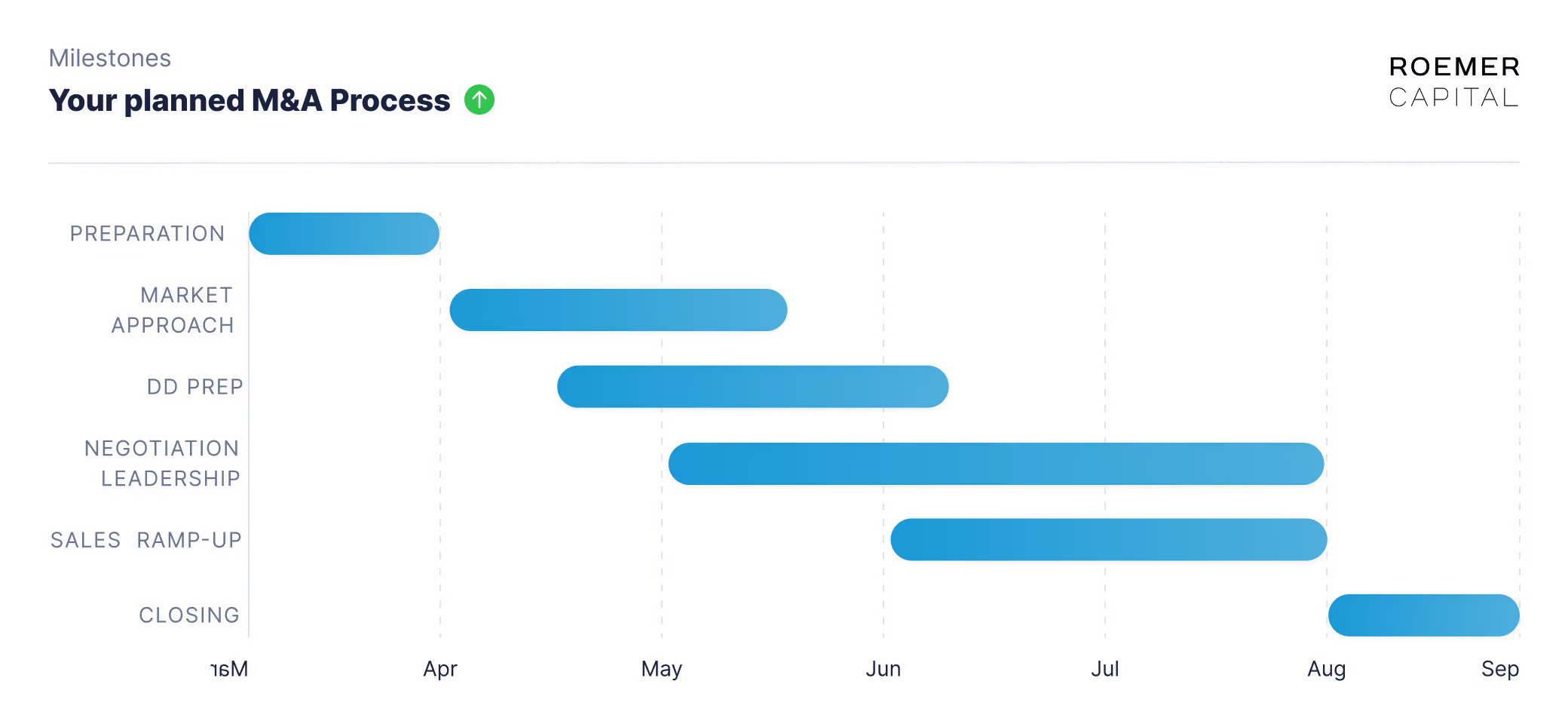
Business succession in Germany follows one of four routes: a handover within the family, a sale to an outside buyer, a takeover by managers (management buyout or management buy in), or keeping ownership while a hired managing director runs the company. Allow three to five years of lead time. The sale or transfer itself usually takes six to twelve months; the rest of the time goes into building management, preparing the numbers and using tax deadlines.
This guide compares the four routes, works through what you and your family actually keep from a company worth 6 million euro, and sets out the process step by step. It is written for owners of German companies, including founders and heirs who live abroad.
What does business succession mean?
Succession means your company passes to someone else. Two things can change hands, together or separately: ownership of the shares and management of the business. The transfer can happen during your lifetime, by sale or gift, or on death.
It mostly concerns companies run by their owners, but more and more founders of technology companies face the same question after many years. Besides you and your successor, family, management, the bank, a tax advisor, lawyers and a notary are usually involved, and for a sale often an M&A advisor.
What are the options for business succession?
1. Handover within the family
Shares usually pass to children or other relatives free of charge, often during your lifetime as an anticipated inheritance. To secure your income, you can keep the profits through a usufruct (Nießbrauch) or agree regular payments from your successor.
Three questions need answers. Does a family member want to run the company, and can they? How are siblings treated fairly if they do not join? And how much gift tax is due? German law offers substantial tax relief for business assets, but it is tied to holding periods of several years.
Fits if a capable and willing successor exists in the family and you do not need sale proceeds.
2. Sale to an outside buyer
A strategic buyer, such as a competitor or customer, or a private equity investor takes over. Investors often buy midsize companies as the platform or an add on for a group of businesses in the same sector, and they frequently ask you to reinvest part of your proceeds. The usual path is a structured process with several bidders, due diligence and a purchase agreement, which for GmbH shares must be notarised (section 15 (3) and (4) of the German Limited Liability Companies Act, GmbHG).
Fits if there is no successor in the family or management, or you need the proceeds for retirement. How the sale works, what it costs and how long it takes is covered in our guide to selling a company in Germany.
3. Management buyout or buy in
In a management buyout the existing leadership team buys the company, in a management buy in an outside manager does. The buyers' own money is almost never enough. Financing therefore combines management equity, a bank loan, often money from a private equity investor and a vendor loan, meaning you defer part of the price. In practice the vendor loan is often 10 to 30 percent of the price.
The price in a management buyout is often lower than from a strategic buyer, because there are no synergies and the bank only lends what the company can repay from its cash flow. In return the sale stays discreet and no competitor sees your numbers. Watch the conflict of interest: your managing directors negotiate as buyers and often know the business better than you do.
Fits if you have a strong second management layer that thinks like owners and is willing to take risk.
4. Keep ownership, hand over management
You stay a shareholder and appoint a hired managing director, possibly supervised by an advisory board. An interim manager can bridge the gap while you search. This buys time if your children are still too young or a sale only makes sense later. It only works if the company runs without you and the new management has real authority.
Fits if you want to keep the company in the family but nobody can run it yet.
Worked example: one company, three routes
Bernd is 63 and the sole shareholder of an IT services GmbH. He holds the shares privately; his acquisition cost is 25,000 euro. Adjusted EBITDA is 1.2 million euro, and at an assumed multiple of 5.0 the shares, free of debt, are worth 6.0 million euro. For the gift we assume, to keep it simple, that the tax value is also 6.0 million euro, that investment assets (Verwaltungsvermögen) play no role and that there were no earlier gifts. Transaction costs and church tax are left out.
Route A: sale to an outside buyer for 6.0 million euro
- Capital gain: 6,000,000 minus 25,000 equals 5,975,000 euro.
- Taxable under the partial income method (sections 17 and 3 no. 40 of the German Income Tax Act, EStG): 60 percent of 5,975,000 equals 3,585,000 euro.
- Income tax, simplified at the 45 percent top rate (section 32a EStG) plus 5.5 percent solidarity surcharge on it, together 47.475 percent: 1,701,979 euro (rounded).
- Bernd keeps 6,000,000 minus 1,701,979 equals 4,298,021 euro, almost all of it at closing.
Route B: management buyout at the same price
- Financing: equity from the two managing directors 0.6 million euro (10 percent), private equity investor 1.5 million euro (25 percent), bank loan 2.7 million euro (45 percent), vendor loan 1.2 million euro (20 percent), subordinated, 6 percent interest, repayable after five years. Total 6.0 million euro.
- Paid at closing: 6.0 minus 1.2 equals 4.8 million euro.
- Tax: again 1,701,979 euro, and immediately. The deferred part generally counts towards the sale price in the year of the sale.
- Freely available after tax: 4,800,000 minus 1,701,979 equals 3,098,021 euro.
- Later: 1.2 million euro repaid after five years plus 72,000 euro interest a year, 360,000 euro in total. Bernd pays tax on the interest separately.
Route C: gift to his daughter
- Standard relief for business assets (sections 13a and 13b of the German Inheritance and Gift Tax Act, ErbStG): 85 percent of 6,000,000 equals 5,100,000 euro tax free.
- Remaining value: 900,000 euro. The statutory deduction of up to 150,000 euro does not apply, because it is fully phased out once the remainder reaches 450,000 euro.
- Personal allowance for a child (section 16 ErbStG, as of 2026): 400,000 euro. Taxable: 500,000 euro.
- Gift tax in tax class I at 15 percent (section 19 ErbStG): 75,000 euro.
- Without the relief: (6,000,000 minus 400,000) × 19 percent equals 1,064,000 euro.
- If the daughter sells the company in year four, two fifths of the relief fall away, that is 2,040,000 euro. Tax then rises to (900,000 plus 2,040,000 minus 400,000) × 19 percent equals 482,600 euro, an additional payment of 407,600 euro.
The outcome: selling to an outside buyer leaves Bernd with about 4.3 million euro after tax. In the management buyout he has about 3.1 million euro at first, and 1.2 million euro depends on his successors for five years. With the gift he receives nothing. In return the family pays only 75,000 euro in tax and keeps a company worth 6 million euro, provided the daughter keeps to the holding period of five years and the payroll rule.
None of the routes is better in itself. Three questions decide: What will you live on after the handover? Is there a successor who wants to do it and can? And how much risk do you still want to carry after you step back?
How does the succession process work?
- Take stock three to five years ahead. What do you want to do afterwards and what will you live on? Who could succeed you? Which customers, contracts and decisions depend on you today?
- Plan for emergencies. A lasting power of attorney that explicitly covers your shareholder rights, a deputy in the company such as a second managing director or an authorised signatory (Prokura), and a will that matches the articles of association.
- Reduce dependence on you. Build a second management layer, hand over customer relationships step by step and document knowledge. This takes the longest and adds the most value.
- Prepare the numbers. Several years of accounts, a plan and a clean separation of business and private costs. Buyers and banks expect it, and so does the tax office for a gift.
- Choose a route and run the numbers. With your tax advisor, put sale, management buyout and gift side by side, as in the example above, including any deadlines that are already running.
- Find the successor. In the family, in management, or through a structured sale process. Smaller businesses can also use succession exchanges and the chambers of commerce.
- Put the transfer into contracts. A purchase or gift agreement, for GmbH shares in front of a notary. The notary then files the new shareholder list, and towards the company your successor only counts as a shareholder once listed there (section 16 (1) GmbHG).
- Shape the transition. You usually stay on for a limited time as advisor or managing director. Agree beforehand who decides what and when your role ends.
When should you start planning?
Three to five years before you want to step back. That sounds long, but there are four concrete reasons:
- Allowances: gifts from the same person are added up over ten years (section 14 ErbStG). After that the allowance is available again, so transferring early and in stages lets you use it more than once.
- Holding periods: the relief for business assets requires a holding period of five or seven years. Contributing shares to a holding company starts a lock up period of seven years (section 22 (2) of the German Reorganisation Tax Act, UmwStG).
- Compulsory shares: for the compulsory share claims of close relatives, lifetime gifts count one tenth less for every year that has passed and generally not at all after ten years (section 2325 (3) of the German Civil Code, BGB).
- Value: buyers cut the multiple for high owner dependence. With adjusted EBITDA of 1.2 million euro, every full point of multiple is worth 1.2 million euro of enterprise value. A second management layer cannot be built in a few months.
How to prepare the company for a sale over several years is covered in our guide to exit strategy for founders. What drives the multiple is explained in our guide to company valuation.
How is business succession taxed in Germany?
Gifts and inheritance
The German Inheritance and Gift Tax Act applies. As of 2026 the personal allowances under section 16 ErbStG are 500,000 euro for spouses and registered partners and 400,000 euro for each child, per parent. Rates in tax class I range from 7 to 30 percent (section 19 ErbStG).
Business assets and GmbH shares can qualify for relief. Under the standard relief 85 percent stay tax free, with a holding period of five years and a minimum payroll. Under the optional full relief it is 100 percent, with seven years and a higher payroll requirement, provided investment assets such as surplus cash, securities or let property are no more than 20 percent. GmbH shares only qualify if you hold more than 25 percent or pool your shares with other shareholders under a pooling agreement (section 13b (1) ErbStG). Recipients in tax classes II and III, such as nephews or successors from outside the family, are taxed on the taxable part of the relieved assets as if they were in tax class I (section 19a ErbStG).
Watch the valuation. What counts is the tax value under the German Valuation Act, not the price a buyer would pay. The simplified income method multiplies the average annual earnings of the last three years by a factor of 13.75 (section 203 of the Valuation Act, BewG, as of 2026). For profitable companies this often exceeds the market price, and an expert valuation can then support a lower figure.
If you or your heirs live abroad, German gift and inheritance tax can still apply, depending on residence and on the assets involved (section 2 ErbStG). Have this checked early, because it changes which route makes sense.
Sale
If you sell privately held GmbH shares and held at least 1 percent at any time in the last five years, 60 percent of the gain is taxable (sections 17 and 3 no. 40 EStG). If a holding GmbH owns the shares, 95 percent of the gain is tax exempt (section 8b of the German Corporate Income Tax Act, KStG), but the proceeds then stay in the holding for the time being. For sole proprietorships and partnership interests there is, subject to conditions such as being 55 or older, an allowance and a reduced tax rate, each available only once in a lifetime (sections 16 (4) and 34 (3) EStG).
Giving away privately held GmbH shares does not trigger income tax, only gift tax. If your child later sells the shares, your acquisition cost becomes theirs (section 17 (2) sentence 5 EStG).
Common mistakes in business succession
- Starting too late. If you only plan once the exit is close, you can neither reduce your own role nor use allowances and holding periods.
- No emergency plan. Without a power of attorney and a deputy, the company can be stuck for weeks if you suddenly drop out.
- Documents that contradict each other. Will, articles of association and marriage contract must fit together. The articles take priority: if they do not accept an heir as shareholder, the share can be redeemed against compensation below value (section 34 GmbHG).
- Several heirs sharing one stake. A community of heirs can only exercise the rights from a GmbH share jointly (section 18 (1) GmbHG). Disagreement paralyses the shareholders' meeting.
- Compulsory shares without cash planning. The compulsory share is half of the statutory inheritance share and payable in cash (section 2303 BGB). Without a waiver or a cash reserve, the successor has to take the money out of the company.
- Gifting shortly before a sale. If the recipient sells within the holding period, the relief is lost pro rata, as route C shows.
- No clear role for the outgoing owner. If you keep deciding after the handover, your successor loses authority, and buyers and banks see that as a risk.
Frequently asked questions
When should succession planning start?
Three to five years before you want to step back. That leaves time to build a second management layer, prepare the numbers and use tax deadlines.
Is handing the company to my children cheaper than selling it?
Often in tax terms, not necessarily in economic terms. A gift can be largely tax free thanks to the relief for business assets, but it brings you no proceeds. Whether it works depends mainly on whether a child wants to run the company and can.
Can I hand my company over to my employees?
Yes, as a management buyout by your managers. Because their own money is rarely enough, it usually takes a bank, often a private equity investor and a vendor loan from you. The price that can be financed depends on how much interest and repayment the company can carry from its cash flow.
How do I find a successor for my company?
Look at family and management first, then at outside buyers. For a sale to a third party, a structured process with several bidders is the most reliable way to a fair price. Smaller businesses also find successors through succession exchanges and the chambers of commerce.
Can I still draw income from the company after the handover?
Yes, in several ways. With a gift you can reserve the dividends through a usufruct or agree regular payments. With a sale, a vendor loan pays interest and a consulting agreement for a limited term pays a fee.
What happens if I drop out without a plan?
Statutory succession applies. The shares pass to a community of heirs that can only act jointly. Without a lasting power of attorney, nobody is authorised to exercise your shareholder rights if you are ill or injured.
Can succession be tax free?
For a gift, under conditions, yes. With the optional full relief, 100 percent of the qualifying assets stay tax free if investment assets are no more than 20 percent and the successor keeps to the holding period of seven years and the payroll rule. A sale is almost never fully tax free.
How Roemer Capital helps
Roemer Capital is an independent fundraising and M&A boutique based in Düsseldorf. When succession runs through a sale to a third party or a management buyout, we support shareholders of technology companies with a product on the market and existing revenue through the whole process. We model the options, prepare documents and data room, approach buyers and negotiate the price and how it is paid. Tax and legal structuring stay with your tax advisor, your lawyers and the notary.
If it is purely a gift within the family without a sale, you usually do not need us; a tax advisor, lawyers and a notary are the right people. Read more about our M&A advisory for sales and succession, or book an intro call to talk through your options.
Note
As of October 2026. This article is not legal or tax advice.
FAQs
Here you can find the important questions.