Exit Strategy: How Founders Prepare a Company Sale


Whether you're refining your pitch, planning your fundraising strategy, or scaling your business: we're here to help.






- An exit strategy sets out how, when and to whom you sell, and what has to be ready by then.
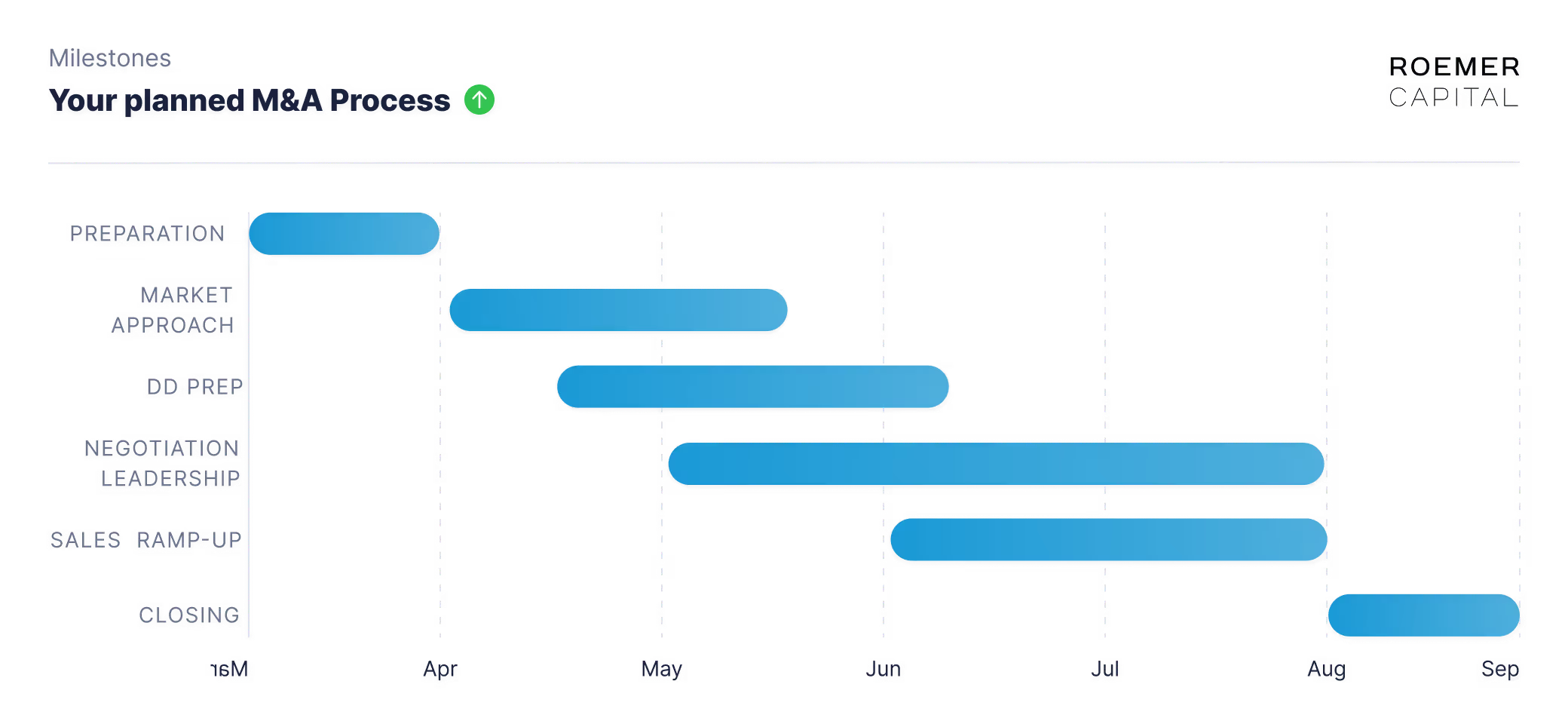
- Allow 18 to 24 months: roughly one year of preparation, then 6 to 12 months for the sale process.
- The typical routes are a trade sale, a sale to a financial investor, a management buyout and a secondary. An IPO is the exception.
- Every euro of sustainable EBITDA counts several times: at an assumed multiple of 7, an extra 100,000 euro of EBITDA adds about 700,000 euro of enterprise value.
- Buyers check governance, quality of the numbers, founder dependence, contracts, intellectual property and tax structure.
- A holding set up shortly before the sale often helps little, because a tax-neutral contribution triggers a seven-year lock-up in Germany.
An exit strategy sets out how, when and to whom you want to sell your company or your shares, and what has to be in place by then. Allow 18 to 24 months in total: roughly one year of preparation, followed by 6 to 12 months for the sale process itself. Most of the price is made during preparation, because buyers pay for clean numbers, low dependence on the founder and orderly contracts and rights.
This guide walks you through the typical exit routes, a preparation timeline, the value drivers that move the price (with a worked example) and the mistakes that cost founders the most money in a sale.
What is an exit strategy?
An exit is the moment when founders or investors sell some or all of their shares and turn the value they have built into cash. The exit strategy is the plan for that moment. It answers four questions:
- What do you want: a full exit, a partial sale or a strong partner for the next stage of growth?
- Who could realistically buy?
- When is the right time?
- What has to be ready inside the company by then?
Having an exit strategy does not mean you want to leave tomorrow. Investors ask about it as early as your funding rounds, because they need to get their money back at some point and many funds have a limited life. If you know early which buyer is likely to be interested later, you can build the company in that direction on purpose.
What exit options do founders have?
For technology companies there are five typical routes. They differ in who buys, how much you sell and how long you are still needed afterwards.
Trade sale to a strategic buyer
In a trade sale, a company from the same or a neighbouring industry buys yours. It pays for product, customers, technology or team and often counts on synergies, meaning benefits that only arise from combining the two businesses. That is why a strategic buyer can often pay more than a financial investor. The catch: the buyer is frequently a competitor, so you have to control carefully what they see and when.
Sale to a financial investor
Private equity funds buy companies to develop them for a few years and then sell them on. They look for stable profits, recurring revenue and a management team that works without the founders. They often expect you to keep part of your shares or reinvest alongside them (a rollover) and to stay on for a few years. Part of the price is frequently tied to future targets through an earn-out.
Management buyout
In a management buyout, the existing management team buys the company. The upside: the buyers know the business, and the handover stays discreet. The downside: managers rarely have enough money of their own. The price therefore depends on how much bank debt, equity from a fund and vendor financing can be raised. With vendor financing, you defer part of the purchase price yourself.
Secondary sale to investors
In a secondary, you sell existing shares to a new or an existing investor. The money goes to you, not to the company. This often happens alongside a funding round. It lets you take some money off the table while you keep building.
IPO as the exception
For most technology companies an IPO is not a realistic exit route. In Germany it requires a stock corporation (AG) or an SE, so a GmbH first has to change its legal form under sections 190 and following of the Transformation Act (UmwG). Costs are high and the duties of a listed company never stop. Nor is it a quick way out: existing shareholders usually agree by contract not to sell their shares for six to twelve months after the listing.
Family succession and a sale to outside managers (a management buy-in) are further options. For founders of technology companies, though, the trade sale, the financial investor and the secondary are usually the ones that matter.
Which exit route fits you?
Your goals should drive the route, not the other way round. These questions help:
- Do you want out completely or to keep going? A full exit needs a buyer who can run the company without you. If you want to keep going, a financial investor or a secondary is the better match.
- How much does the top price matter to you? Strategic buyers often pay the most but are more likely to question the team, the brand and the location.
- Who else has a say? Your investors have their own goals and often rights under the shareholders' agreement, such as a drag-along obligation or a tag-along right.
- How profitable are you? Financial investors and management buyouts need predictable profits, because they pay part of the price with debt. A trade sale can work even with losses if the technology or the customers are a strategic fit.
When should you start planning your exit?
Earlier than most founders think. The sale process itself usually takes 6 to 12 months. The things that set the price take longer: a second management layer, reliable monthly figures over several years and orderly contracts. A proven timeline, counted from today:
- Months 1 to 3, goals and stocktake: decide what you want to achieve and by when. Get a first valuation range and check honestly what a buyer would criticise today.
- Months 3 to 6, structure: move reporting to clean monthly figures, plan the second management layer and tidy up the cap table and the shareholders' agreement.
- Months 6 to 12, value drivers: reduce dependence on single customers and on yourself, document one-off items and secure contracts and rights.
- Months 10 to 12, documents: data room, company profile and a three-year plan. Where it pays off, commission a vendor due diligence, a review of your own company that you order before buyers start theirs.
- From month 12, a sale process of 6 to 12 months: buyer outreach, offers, due diligence, negotiation, signing and closing.
Tax structure is the exception. If you want to sell through a holding company, you often need years of lead time. More on that below.
A detailed roadmap with checkpoints for every phase is in Roemer Capital's Exit Checklist 2026. How tech startups use it as a working plan is explained in our post on the company sale for tech startups.
What drives the price in a company sale?
Buyers pay for future profits and for how certain those profits are. For profitable companies, value is often calculated as a multiple of adjusted EBITDA, which is earnings before interest, tax, depreciation and amortisation, cleaned of one-off items. For fast-growing software companies without profits, revenue often serves as the basis. How the methods work in detail is covered in our guide to company valuation methods.
The multiple rises or falls with the risk the buyer sees. The strongest value drivers are:
- Recurring revenue: contracts with ongoing payments are easier to forecast than one-off deals.
- Growth and margin: both together, and backed by evidence.
- A broad customer base: if a large share of revenue depends on one customer, the price drops.
- Independence from the founder: the business has to run without you.
- Quality of the numbers: only figures that hold up in due diligence protect the price until signing.
Worked example: what preparation is worth
A software company reports EBITDA of 1.6 million euro. That figure includes one-off legal costs of 200,000 euro. The two founders pay themselves a combined 120,000 euro less than a hired management team would cost. We assume a multiple of 7. This is a figure for the calculation, not a market value.
- Adjusted EBITDA: 1.6 million euro plus 200,000 euro of one-off costs minus a 120,000 euro salary adjustment equals 1.68 million euro.
- Enterprise value: 1.68 million euro × 7 = 11.76 million euro.
- Price for the shares: net debt is deducted from the enterprise value. With a 1.5 million euro bank loan and 0.9 million euro of cash, net debt is 0.6 million euro. That leaves 11.16 million euro.
Now two cases where preparation is missing:
- One-off costs not documented: if the buyer cannot verify the 200,000 euro, they work with EBITDA of 1.48 million euro. At a multiple of 7 that is an enterprise value of 10.36 million euro, or 1.4 million euro less.
- Founder dependence: if one founder personally manages the largest customer, who brings 40 percent of revenue, the buyer sees more risk and might cut the multiple to 6. That gives 1.68 million euro × 6 = 10.08 million euro, or 1.68 million euro less. Alternatively, the buyer moves part of the price into an earn-out that only pays if the customer stays.
The rule of thumb: every euro of sustainable EBITDA counts several times over in the price. At a multiple of 7, an extra 100,000 euro of lasting EBITDA adds about 700,000 euro of enterprise value. Every doubt about your numbers costs a multiple in the same way.
Exit readiness: what do buyers check in due diligence?
Exit readiness means your company passes a buyer's review without the price crumbling along the way. Six areas decide.
Governance and shareholders
The buyer wants to know who owns what and who has to approve the deal. Check that your cap table matches the shareholder list filed with the commercial register. In a German GmbH, only the people on that list count as shareholders towards the company (section 16 (1) of the GmbH Act). Many articles of association require consent before shares can be sold (section 15 (5) of the GmbH Act). Find out early whether the required majority is in place and whether a drag-along clause binds every shareholder. Resolutions, minutes and investor agreements all belong in the data room.
Quality of the numbers
Buyers want the annual accounts of recent years, current monthly figures, budget versus actuals and a plan for the coming years. Every adjustment to EBITDA needs evidence. The numbers in the company profile, the financial model and the data room have to match. If you have gaps here, get help early, for example from a fractional CFO. What that role covers, and when an interim CFO fits better, is explained in our guide on interim CFO vs. fractional CFO.
Dependence on the founder
Buyers buy a system, not a person. If your key customers, the technical knowledge and every decision depend on you, the price drops or part of it moves into an earn-out. Build a second management layer, hand over customer relationships and write down how things work. Even so, expect to stay on for a while after the sale.
Contracts
Review your most important contracts with customers, suppliers, banks and landlords. Watch especially for change of control clauses that give the other side a right to terminate when the owner changes. Employment contracts of key people, non-compete clauses and employee share plans belong on the list too. Whatever is not in writing does not exist for the buyer.
Intellectual property
In a technology company the software is often the most valuable asset. Under German copyright law, the economic rights in software that employees write as part of their job belong to the employer (section 69b of the Copyright Act, UrhG). That does not apply automatically to freelancers or to code the founders wrote before the company existed. For those you need written agreements that grant the company the rights of use. Also check trademarks, domains and the licences of any open source software you use.
Tax and structure
How much of the price reaches you depends on how you hold your shares. If you hold them privately and owned at least 1 percent at any time in the last five years, the gain is taxable under section 17 of the German Income Tax Act (EStG), with 60 percent of it taxed under the partial income method (section 3 no. 40 EStG). If a holding GmbH sells, the gain is effectively 95 percent tax-free under section 8b (2) and (3) of the Corporate Income Tax Act (KStG). If you move your shares into a holding tax-neutrally shortly before the sale, a seven-year lock-up applies. If the holding sells within that period, you are taxed retroactively under section 22 (2) of the Reorganisation Tax Act (UmwStG). The amount taxed falls by one seventh for every full year since the contribution. Settle the structure early with your tax adviser.
How long does a company sale take?
Usually 6 to 12 months from preparing the documents to closing. Well-prepared processes are faster, because most time is lost when documents are missing in due diligence or the numbers do not match. The process in short:
- Prepare the documents: an anonymous short profile (teaser), a detailed company profile, the financial model and the data room.
- Approach suitable buyers and sign non-disclosure agreements.
- Collect non-binding offers and compare them.
- Run due diligence with selected bidders.
- Negotiate and sign the purchase agreement. For a German GmbH, both the obligation to transfer and the transfer of shares must be notarised (section 15 (3) and (4) of the GmbH Act).
- Closing: the price is paid and the shares pass to the buyer.
Process, timeline and costs are covered in detail in our guide on selling a company.
Do you need an M&A adviser?
Not always. If the buyer is already known and you trust them, for example in a sale to your own management, an experienced law firm and your tax adviser are often enough. An adviser pays off when you want several buyers competing for real, when the process has to run next to daily business and when enough money is at stake that a well-run process clearly outweighs the cost.
Common mistakes
- Starting too late. If you only plan once money or patience runs out, you negotiate under pressure, and buyers notice.
- Talking to only one interested party. Without an alternative you lose bargaining power, especially if you grant exclusivity early.
- Treating the last funding round as a floor. A buyer works with their own numbers, not with the valuation of your last round.
- Not documenting adjustments. Every one-off item without evidence disappears in due diligence and costs a multiple in the price.
- Keeping everything tied to you. Without a second management layer, part of the price turns into an earn-out, or you stay committed for longer than planned.
- Leaving rights and contracts open. Missing IP assignments for software or overlooked change of control clauses almost always surface in the review.
- Sorting out tax last. A holding set up shortly before the sale often fails to deliver the hoped-for benefit because of the lock-up period.
- Neglecting the business. If revenue or margin dips during the process, the buyer renegotiates.
Frequently asked questions
What is an exit strategy?
An exit strategy is the plan for how, when and to whom founders or investors sell their shares. It defines the goal, the likely buyers, the timing and the steps needed to prepare.
When should I start preparing for an exit?
About 18 to 24 months before the planned sale. A second management layer and reliable monthly figures cannot be built in a few weeks. If a holding structure is involved, you need even more lead time because of the seven-year lock-up.
How long does it take to sell a company?
Usually 6 to 12 months from preparing the documents to closing. How fast it goes depends mainly on how well the documents are prepared.
What are the main exit options for founders?
The main options are a sale to a strategic buyer (trade sale), a sale to a financial investor, a management buyout and a partial sale of shares (secondary). An IPO is the exception for most technology companies.
What does exit readiness mean?
Exit readiness means your company passes due diligence without the price falling. It takes clean numbers, orderly shareholder arrangements, reviewed contracts, secured rights to your software and a team that works without you.
Do I have to stay on after the sale?
Often yes, at least for a transition period. How long depends on the buyer and on how much the business depends on you. Financial investors often expect founders to stay for a few years and keep a stake.
What is an earn-out?
An earn-out is part of the purchase price that is only paid after closing if the company reaches agreed targets. Buyers use it when they doubt the plan or the company's independence from the founder.
How Roemer Capital helps
Roemer Capital is an independent fundraising and M&A advisory boutique based in Düsseldorf. We support technology companies that have a product in the market and running revenue in a company sale, from preparation through buyer outreach to closing. A sale usually takes 6 to 12 months, and we generally work towards six. Our fee is a fixed monthly retainer plus a success fee that is only due if the sale happens and is based on the price achieved.
If you want to check where you stand first, the Exit Checklist is a good place to start. To talk through your situation, book an intro call.
Note
As of October 2026. This article is not legal or tax advice.
FAQs
Here you can find the important questions.