Company Sale for Tech Startups: Preparing Your Exit with the Exit Checklist


Whether you're refining your pitch, planning your fundraising strategy, or scaling your business: we're here to help.






Why an unstructured company sale fails
Most tech startup exits do not fail for lack of buyer interest. They fail for lack of preparation before the first teaser goes out. You have traction, a deck, and a price idea. Then conversations start. After three meetings you notice: numbers contradict each other, governance wobbles, and diligence eats pace. Closing dies quietly. That applies to SaaS as much as to e-commerce, DTC, and marketplaces.
A company sale is not a lucky moment. It is the result of structural, financial, and strategic planning. The sale process itself usually takes 6 to 12 months; preparation starts well before that. Every company is saleable. What decides is price and condition. If you only look at the business through an investor lens once the process is running, you negotiate from defense.
That is why we publish Roemer Capital’s Exit Checklist 2026. It is the playbook we give teams before sell-side M&A advisory gets serious. Our work shows a clear pattern: sequence beats hope. Value comes from preparation.
Exit readiness is an operating system, not a PDF status
A checklist only works when you run it like an OS: clear phases, owners, weekly cadence, definition of done. Otherwise it stays a bookmark. We see the same break again and again: founders polish the equity story while adjusted EBITDA, a second management layer, and the data room still wobble. Buyers notice that in minute ten of diligence.
The OS principle in three lines:
- Input: actuals, target picture (full sale or partial exit), cap table, risks.
- Process: phases from preparation to closing, value creation, vendor checks.
- Output: saleable numbers, governance, data room, a durable equity story in the transaction.
If one of those strands is missing, you lose bargaining power. If all three run, even a selective market window looks more professional. Exit strategy is then not a feeling. It is demonstrable consistency.
How to use the Exit Checklist as your operating system
Download the checklist and do not treat it as reading material. Treat it as a sprint backlog across all phases. The phases from the white paper:
- Analysis (months 0 to 3): target valuation (company valuation as compass), time horizon, personal goals (liquidity, partial exit, full sale). Roughly match investor types. Exit scorecard instead of gut feel.
- Structure (months 3 to 6): governance, controlling, KPI dashboard. Plan a second management layer. Touch cap table and legal hygiene.
- Optimization (months 6 to 15): lift EBIT and cash flow. Adjusted management accounts, add-backs, shorten the CCC. Steer recurring revenue and concentration.
- Preparation (months 12 to 15): data room, information memorandum, plans. Vendor DD before the buyer reviews.
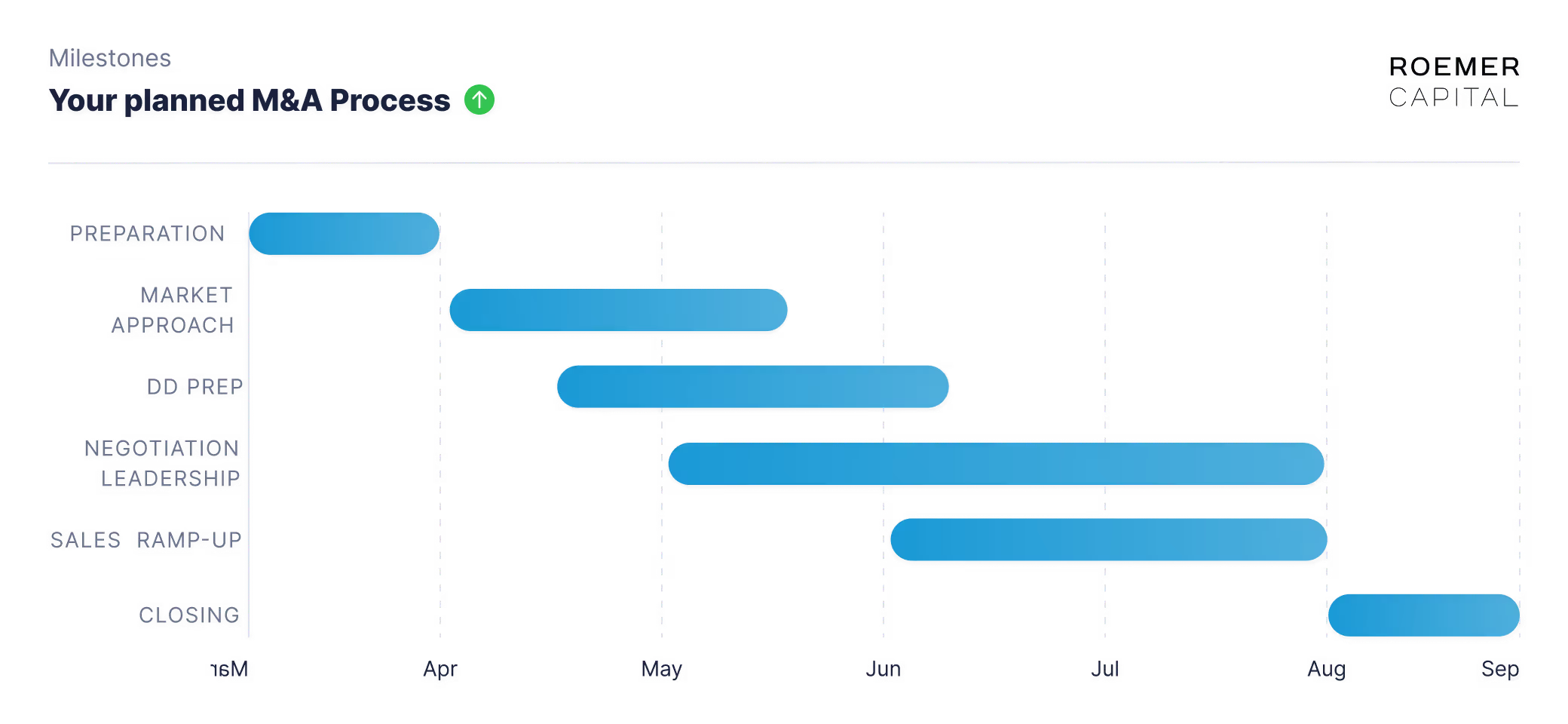
- Transaction (months 15 to 24): longlist, teaser, meetings, NBO, due diligence, SPA. A process with alternatives, not one "strategic friend."
The checklist does not only tell you what is missing. It helps you steer sequence and depth. That is what separates prep from panic. It also includes a worked SaaS example: so you see how a dashboard, a second layer, and recurring revenue translate into an exit case without inventing the deal yourself.
Open the Exit Checklist 2026 now
Paths: trade sale, PE, secondary, partial exit
Your target picture drives the structuring logic. Four realistic routes for tech scaleups:
- Trade sale: a strategic buyer pays for synergies, product, customers, or talent. Integration fit often counts harder than perfect governance alone.
- Private equity / buy-and-build: private equity wants transparency, scalable structures, and often a platform or add-on logic. Organic growth plus acquisitions, multiple expansion, deleveraging.
- Secondary: existing shareholders sell shares, often next to primary. Liquidity without a full sale.
- Partial exit: you realize part of the value, keep skin in the game (roll-over), and keep building.
As a contrast: venture capital often seeks aggressive growth and upside. PE underwrites profitability, recurring revenue, and controllability harder. Align finance and governance with the buyer set you actually want. More context on capital partners is in our post on investor types.
Value drivers that move price
Simply put: enterprise value = EBITDA × multiple ± net debt (cash minus debt). EBITDA shows operating earning power. The multiple reflects growth, risk, scalability, and comparable transactions. Net debt shifts equity value. Every extra euro of durable EBITDA acts like a lever depending on the multiple, not like a one-off effect.
In practice, these decide most:
- Adjusted EBITDA: one-offs and add-backs documented, not "beautified."
- Recurring revenue: predictability beats one-off spikes. Buyers pay for repeatability.
- Governance and second layer: investors buy systems, not people. A CFO, COO, or Head of Sales reduces founder dependency.
- Data room: navigable, current, consistent with deck and forecast.
- Cash conversion cycle: less capital tied up, more credibility in cash flow.
Professional reporting (monthly management accounts, plan vs. actual, 24-month forecast, EBITDA bridge) is mandatory, not nice-to-have. Investing early here shortens every later diligence. Details and checklist blocks live in the Exit Checklist; this article does not dump the full list.
Common mistakes the checklist prevents
- Starting an exit while adjusted numbers and actuals are still unreconciled.
- Starting too late: ignoring the lead time before the sale until cash or shareholder pressure burns.
- Treating the last VC valuation as a floor instead of building buyer logic and alternatives.
- Pushing a dirty cap table, side letters, and unclear options deep into diligence.
- Dismissing founder dependency and a missing second layer as "fine for now."
- One interested party plus early exclusivity with no competition in the process.
- Treating the checklist as a one-off workshop instead of a phased OS.
The common thread: structure is missing before the buyer is missing. Flip that order and you collect discounts or broken processes.
Optional next step: M&A advisory
If you do not want to orchestrate the process alone, sell-side support is the next lever: positioning, buyer outreach, diligence prep, negotiation cadence. More on our page for M&A advisory for company sales. The checklist remains the operational core for prep. Advisory scales the process. The checklist makes you exit-ready.
How you know your exit OS is working
After the first prep months you should see these signals:
- You explain adjusted EBITDA and the KPI dashboard without spreadsheet chaos.
- The target picture (full sale, partial exit, secondary) is written and aligned with shareholders.
- Data room, forecast, and equity story tell the same story.
- Second-layer and key-person risks are named, not hidden.
- You can pull an update pack for interested buyers in under an hour.
If conversations still stick on basics, the checklist is not "live" yet. Go back into the phase, not into more outreach. More calls with an unfinished OS only multiply the same mistake.
Conclusion
A company sale without structure costs price and closing certainty. Exit strategy is not a status badge. It is an operating system of target picture, numbers, governance, and process. Our Exit Checklist gives you exactly that playbook for tech startups and scaleups: phases from analysis to transaction, value drivers, buyer logic, built for practice.
Read the Exit Checklist 2026 and run it as your prep OS
If you want guided implementation from gap analysis to transaction, we are happy to talk in a strategy call. We support tech scaleups sell-side in M&A advisory.
Book a strategy call on exit and company sale
FAQs
Here you can find the important questions.