Selling GmbH Shares in Germany: Process, Notary, Tax


Whether you're refining your pitch, planning your fundraising strategy, or scaling your business: we're here to help.






- Both the sale agreement and the transfer of GmbH shares must be notarised under section 15 (3) and (4) GmbHG, otherwise the sale is invalid.
- Check the articles of association and the shareholders' agreement first: transfer restrictions, rights of first refusal, tag-along and drag-along rights shape the timetable.
- The buyer pays the equity value: enterprise value minus debt plus cash, fixed through a locked box or closing accounts.
- Private sellers with at least 1 percent pay tax on 60 percent of the gain (sections 17 and 3 no. 40 EStG), just under 28.5 percent at the top rate.
- Through a holding GmbH, 95 percent of the gain is tax free under section 8b KStG, but tax follows when the money is paid out.
To sell shares in a German GmbH, you sign a share purchase agreement with the buyer in front of a German notary. Section 15 (3) and (4) of the German GmbH Act (GmbHG) requires notarisation of both the sale agreement and the transfer, and afterwards the notary files an updated shareholder list with the commercial register. If you hold 1 percent or more privately, 60 percent of your gain is taxed at your personal rate, while a holding GmbH pays tax of roughly 1.5 percent of the gain.
Below you will find the process in nine steps and a worked example of what is left of 11 million euro after tax, held privately and through a holding.
What actually happens when you sell GmbH shares?
You sell your shares in the company, not the business itself. This is called a share deal. The sellers are the shareholders, not the GmbH. The company stays exactly as it is, with all its contracts, employees, licences, debts and risks. Only the owner changes.
Three things follow from that:
- Contracts continue without the other party having to agree. The exception is a change of control clause, which gives customers, licensors or lenders a right to terminate when the owner changes.
- Nothing changes legally for employees. The GmbH remains the employer, and section 613a of the German Civil Code (BGB) on transfers of business does not apply.
- The buyer takes over every risk from the past, including the unknown ones. So the buyer checks the company closely and asks you for warranties.
The alternative is an asset deal, where the GmbH itself sells individual assets and the proceeds first land in the company, not with you. For technology companies, the share deal is the normal route.
What are the steps to sell GmbH shares?
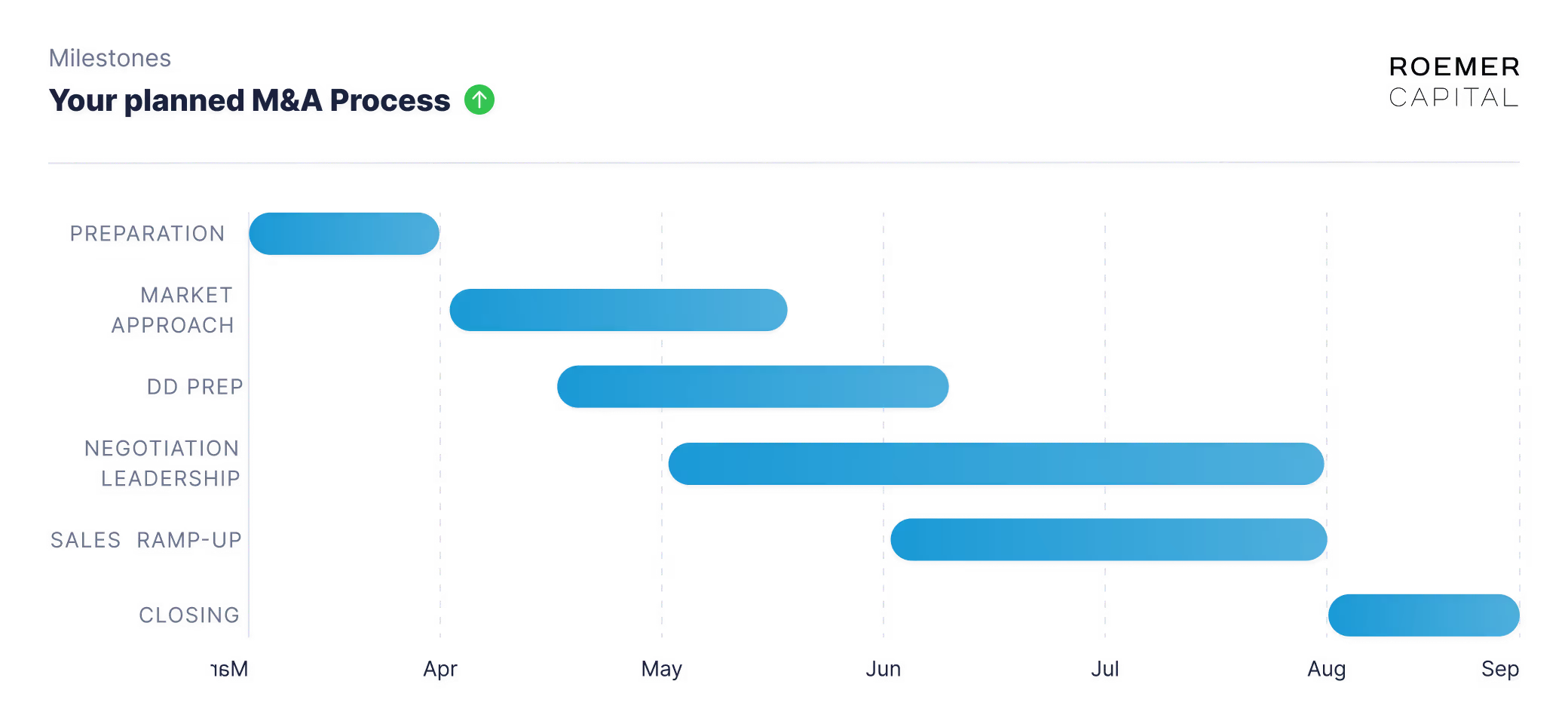
A share sale almost always follows the same order. The first two steps are the ones people skip most often, and they cost the most time later.
- Read the articles of association and the shareholders' agreement. Do you need consent? Do other shareholders have a right of first refusal or a tag-along right? Is there a drag-along obligation?
- Check how you hold the shares and what that means for tax. Do you hold them privately or through a holding company? Did you own at least 1 percent at any point in the last five years? Changing the structure takes time, so this comes early.
- Prepare the documents. Annual accounts, current figures, the business plan, key contracts, the shareholder list and past resolutions belong in a well-organised data room.
- Find buyers and protect confidentiality. Interested parties sign a non-disclosure agreement (NDA) before they see details.
- Offer and letter of intent. The buyer sets out price, price mechanism and key terms, often in a letter of intent (LOI). Usually only exclusivity, confidentiality and costs are binding at this stage.
- Due diligence. The buyer reviews finance, legal, tax and technology. In a company sale this often takes six to twelve weeks. Our glossary explains due diligence in detail.
- Negotiate the share purchase agreement (SPA). The lawyers on both sides agree on price, warranties, indemnities and closing conditions.
- Signing. Buyer and seller conclude the SPA before the notary. From this point, both are bound.
- Closing. Once all conditions are met, the buyer pays, the shares pass to the buyer, and the notary files the new shareholder list.
If you sell to a co-shareholder who already knows the business, steps three to six are usually much shorter. For a full sale process to an outside buyer, see our guide to the phases of the M&A process.
Why do you need a notary to sell GmbH shares?
Because German law requires it. Under section 15 (4) GmbHG, the agreement that obliges you to transfer the shares must be notarised. Under section 15 (3) GmbHG, the same applies to the transfer itself. A sale agreed by email, by handshake or with a simple signature is therefore invalid.
The notarial deed has to cover the entire agreement, including every schedule it refers to. Side agreements that are not in the deed make the obligation invalid for lack of form. Only the notarised transfer cures that defect, so everything that is meant to apply belongs in the deed.
At the appointment, the notary generally reads the whole deed aloud, schedules included (section 13 of the Notarisation Act, BeurkG). Long schedules, such as the disclosure letter, are often notarised beforehand in a reference deed (section 13a BeurkG) and need not be read again. You can be represented by proxy, but notaries usually want a written, often certified power of attorney, and foreign companies must prove who may represent them. Missing identification documents under the Anti Money Laundering Act can delay the appointment.
What happens after signing
In German SPAs, the transfer is usually declared at signing but made conditional on payment of the purchase price (section 158 (1) BGB). No second notary appointment is needed. Once the buyer pays, the transfer takes effect, and the notary files a new shareholder list with the commercial register (section 40 (2) GmbHG).
Only from the moment the buyer appears on that list is the buyer treated as a shareholder by the company (section 16 (1) GmbHG). A buyer cannot rely on the list alone, because acquiring shares in good faith from someone who is listed but does not own them is only possible within narrow limits under section 16 (3) GmbHG. That is why the buyer asks you to warrant that you own the shares free of third-party rights.
What the notary costs
Notary fees follow the German Court and Notary Fees Act (GNotKG) and are based on the transaction value, which in a share sale is essentially the purchase price. They rise less than proportionally with the value. The SPA decides who pays, and it is often the buyer.
Do the other shareholders have to agree?
That depends on the articles of association and the shareholders' agreement. Under section 15 (5) GmbHG, the articles can make a transfer subject to further conditions, in particular the approval of the company or the shareholders' meeting. Without the required approval, the transfer is invalid.
In a GmbH with investors, the shareholders' agreement usually adds three rights:
- Right of first refusal: your co-shareholders may buy your shares first, on the terms you notify to them.
- Tag-along right: your co-shareholders may sell their shares to your buyer on the same terms. If the buyer only wants a fixed number of shares, you sell fewer yourself.
- Drag-along obligation: if an agreed majority sells, the remaining shareholders must sell on the same terms. This lets a buyer acquire 100 percent even if not everyone agrees.
These rights come with deadlines, often two to four weeks from the sale notice for a tag-along right. The cleanest approach is to collect written waivers before signing. Note that a shareholders' agreement obliging you to transfer shares, for example through a right of first refusal or a drag-along clause, must itself be notarised under section 15 (4) GmbHG. Otherwise the obligation cannot be enforced.
How is the price for GmbH shares calculated?
Negotiations usually start with the enterprise value, the value of the operating business. What the buyer pays for the shares, though, is the equity value. The bridge between the two looks like this:
- Enterprise value, calculated as if the GmbH had no cash and no financial debt (cash-free, debt-free)
- minus financial debt, such as bank loans and shareholder loans
- minus debt-like items, such as tax liabilities for past periods or unpaid bonuses
- plus freely available cash
- depending on the SPA, plus or minus the difference between actual working capital and an agreed target
How to arrive at the enterprise value in the first place is covered in our guide to company valuation methods.
Locked box or closing accounts
The price mechanism decides on which date this bridge is drawn up. There are two models:
- Locked box: the price is fixed on the basis of a balance sheet from before signing. From that date, profits and losses belong economically to the buyer. In return, you promise that no value leaks out of the GmbH to you before closing (leakage), for example through dividends, consulting fees or interest on shareholder loans. To compensate you for the waiting time, the fixed price often carries interest until closing.
- Closing accounts (completion accounts): the buyer pays a provisional price at closing based on estimates. Accounts are then drawn up as of the closing date, and the difference is settled. Without a dispute, the final price is often known three to six months after closing.
A locked box gives you price certainty, but it needs a reliable balance sheet that is not too old. With closing accounts, the accounting rules in the SPA decide how much you actually receive.
Deferred parts of the price
Not every euro arrives on the closing date. Common are an escrow holdback that secures warranty claims, often around 5 to 15 percent of the purchase price, an earn-out that depends on future targets, and a vendor loan where you defer part of the price. Always compare offers by what you receive at closing, not by the biggest number.
Which warranties do you give as a seller?
The buyer takes over the GmbH with its whole history and therefore asks you to guarantee certain facts. Statutory warranty law is largely excluded and replaced by independent guarantees whose consequences are defined only by the SPA.
- Title warranties: the GmbH exists validly, the capital contributions have been paid in full, and you own the shares free of third-party rights.
- Business warranties: statements on annual accounts, material contracts, intellectual property, software, employment, tax, data protection and litigation.
- Indemnities: for known risks, above all taxes for periods before the reference date, you hold the buyer harmless regardless of any breach of warranty.
Liability is capped. Typical are a de minimis threshold for small individual claims, a basket for the total of all claims, in practice often 0.5 to 1 percent of the purchase price, and an overall cap. For business warranties, caps of 10 to 30 percent of the purchase price are common, for title warranties the full price. Business warranties often expire 12 to 24 months after closing, title warranties often only after five to ten years.
Liability for intent and fraudulent concealment can never be excluded in advance. Disclose known issues in the disclosure letter, specifically against each warranty. Warranty and indemnity insurance (W&I insurance) can replace all or part of your personal liability.
How is the sale of GmbH shares taxed?
The figures below assume you are tax resident in Germany. The tax depends on who holds the shares and how large the stake is.
- Private individual with at least 1 percent: if you held at least 1 percent at any time in the last five years, section 17 of the Income Tax Act (EStG) applies. The gain counts as business income but is not subject to trade tax. Under the partial income method in section 3 no. 40 EStG, 60 percent is taxable and 40 percent is tax free. Acquisition costs and selling costs also reduce the gain only by 60 percent. At the top rate of 45 percent plus solidarity surcharge, the burden comes to just under 28.5 percent of the gain.
- Private individual below 1 percent: the gain is investment income and is taxed at the flat rate of 25 percent (section 32d EStG) plus solidarity surcharge. The 1 percent threshold looks back five years, so if funding rounds diluted you below 1 percent, section 17 EStG still applies during that time.
- Holding GmbH: if a corporation sells the shares, the gain is effectively 95 percent tax free under section 8b (2) and (3) of the Corporate Income Tax Act (KStG). 5 percent counts as non-deductible expenses and is subject to corporate income tax and trade tax. At a combined burden of around 30 percent (as of 2026), that is about 1.5 percent of the gain. There is no minimum stake and no minimum holding period for this.
A holding defers tax, it does not remove it
When the holding distributes the proceeds to you, they are taxed again in your hands. The advantage is that the money is available almost in full inside the holding for new investments. The worked example below shows the size of the effect.
Inserting a holding shortly before a sale is only tax neutral as a share exchange under section 21 of the Reorganisation Tax Act (UmwStG), on application, and only if the holding then has the majority of the voting rights. If the holding sells the contributed shares within seven years, the increase in value up to the contribution is taxed retroactively in your hands, reduced by one seventh for each full year that has passed (section 22 (2) UmwStG). Selling your shares to your own holding for cash, on the other hand, is a normal sale under section 17 EStG and triggers tax straight away. Have your tax adviser review the structure early.
Two company-level tax issues that affect your price
- Tax loss carryforwards: if more than 50 percent of the shares pass to one acquirer within five years, the GmbH's loss carryforwards are generally lost in full under section 8c KStG. Do not price them into your offer.
- Real estate transfer tax: if the GmbH owns land or buildings, this tax can arise once at least 90 percent of the shares end up with one acquirer or pass to new shareholders within ten years.
Worked example: what is left after tax?
A software GmbH has share capital of 50,000 euro. Founder Anna holds 60 percent privately, with acquisition costs of 30,000 euro. Founder Ben holds 40 percent through a holding GmbH that has existed since the company was founded, with acquisition costs of 20,000 euro. A strategic buyer acquires all shares at an enterprise value of 12 million euro under a locked box.
The calculation is simplified. For Anna, the top rate of 45 percent plus 5.5 percent solidarity surcharge is applied to the entire gain. For the holding, the combined tax rate is 30 percent (as of 2026). Church tax is ignored. Fees for lawyers, tax advisers and the M&A adviser total 220,000 euro and are split by shareholding.
- Locked box balance sheet: financial debt 2.0 million euro, debt-like items 0.3 million euro, cash 1.3 million euro.
- Price for all shares: 12.0 minus 2.0 minus 0.3 plus 1.3 equals 11.0 million euro. Anna receives 6,600,000 euro, Ben's holding 4,400,000 euro.
- Anna's capital gain: 6,600,000 minus 30,000 acquisition costs minus 132,000 share of fees equals 6,438,000 euro.
- 60 percent is taxable, so 3,862,800 euro. The tax rate is 45 percent times 1.055, which is 47.475 percent. Tax: 1,833,864 euro (rounded).
- Anna keeps 6,600,000 minus 132,000 minus 1,833,864, which is 4,634,136 euro. That is a tax burden of around 28.5 percent of the gain.
- The holding's gain: 4,400,000 minus 20,000 minus 88,000 equals 4,292,000 euro. 5 percent is taxable, so 214,600 euro. Tax at 30 percent: 64,380 euro, around 1.5 percent of the gain.
- The holding keeps 4,400,000 minus 88,000 minus 64,380, which is 4,247,620 euro.
Had Ben sold privately, the same calculation as for Anna would have left him with 3,089,424 euro. Inside the holding he has 4,247,620 euro to work with, around 1.16 million euro more for new investments.
If the holding pays everything out to Ben, flat rate tax of 26.375 percent including solidarity surcharge applies, which is 1,120,310 euro. Ben then keeps 3,127,310 euro, only 37,886 euro more than with a private sale. The benefit of the holding lies in reinvesting, not in saving tax for good.
Common mistakes
- Reading the articles too late. Transfer restrictions, rights of first refusal and investor consents must be satisfied or waived before closing. Finding them just before the notary appointment costs weeks.
- Side agreements outside the deed. An oral promise or a side letter that is not notarised makes the obligation invalid for lack of form.
- Setting up the holding too late. A contribution shortly before the sale triggers partial retroactive taxation during the seven-year lock-up period.
- Signing warranties without checking them. Test every warranty against the documents. If you knew about an issue and kept quiet, no liability cap protects you.
- No reserve for the tax bill. A large capital gain is followed by a tax payment and often higher advance tax payments.
Frequently asked questions
Can I sell GmbH shares without a notary?
No. Both the sale agreement and the transfer must be notarised under section 15 (3) and (4) GmbHG, otherwise the sale is invalid. Only preparatory documents such as an NDA or a non-binding LOI can be signed without a notary.
Can I sell GmbH shares tax free?
Usually not completely. The closest you get is a sale through a holding GmbH, where 95 percent of the gain is effectively tax free under section 8b KStG. As a private individual with at least 1 percent, you pay your personal rate on 60 percent of the gain.
How long does it take to sell GmbH shares?
A sale to an outside buyer usually takes 6 to 12 months from preparation to closing. A sale to a co-shareholder is often faster because the review is shorter. Between signing and closing, there are often only a few days without regulatory approvals, and several weeks if merger control applies.
Can a foreign buyer acquire GmbH shares?
Yes, but some deals need clearance first. If a buyer from outside the EU and EFTA acquires voting rights, the Federal Ministry for Economic Affairs can review the deal under the Foreign Trade and Payments Act and Ordinance (AWG and AWV). In sensitive sectors such as critical infrastructure, artificial intelligence, robotics or semiconductors, a filing is mandatory above certain thresholds, and closing must wait for clearance.
Does moving abroad before the sale avoid German tax?
Usually not. If you hold 1 percent or more, section 6 of the Foreign Tax Act (AStG) can treat the move itself like a sale at current value, even though no money flows. Have this checked before you move, not after.
How Roemer Capital helps
Roemer Capital is an independent fundraising and M&A boutique based in Düsseldorf. We support shareholders of technology companies with a product in the market and ongoing revenue when they sell their company, from preparation and buyer outreach to negotiating the SPA. The SPA itself and the notarisation are handled by your lawyers and the notary.
A sale usually takes 6 to 12 months, and we generally work towards six months. Our fee consists of a monthly retainer and a success fee that is only due if a sale happens and is based on the price achieved. If you are only selling to a co-shareholder and the price is already agreed, you usually do not need an M&A adviser. A lawyer, a tax adviser and a notary are enough.
Learn more about our M&A advisory for company sales, read our overview of selling a company, or book an intro call.
Note
As of October 2026. This article is not legal or tax advice.
FAQs
Here you can find the important questions.