Selling a Company in Germany: Process, Timeline and Costs


Whether you're refining your pitch, planning your fundraising strategy, or scaling your business: we're here to help.






- A company sale runs in three phases: preparation, confidential approach to buyers, and negotiation through to closing.
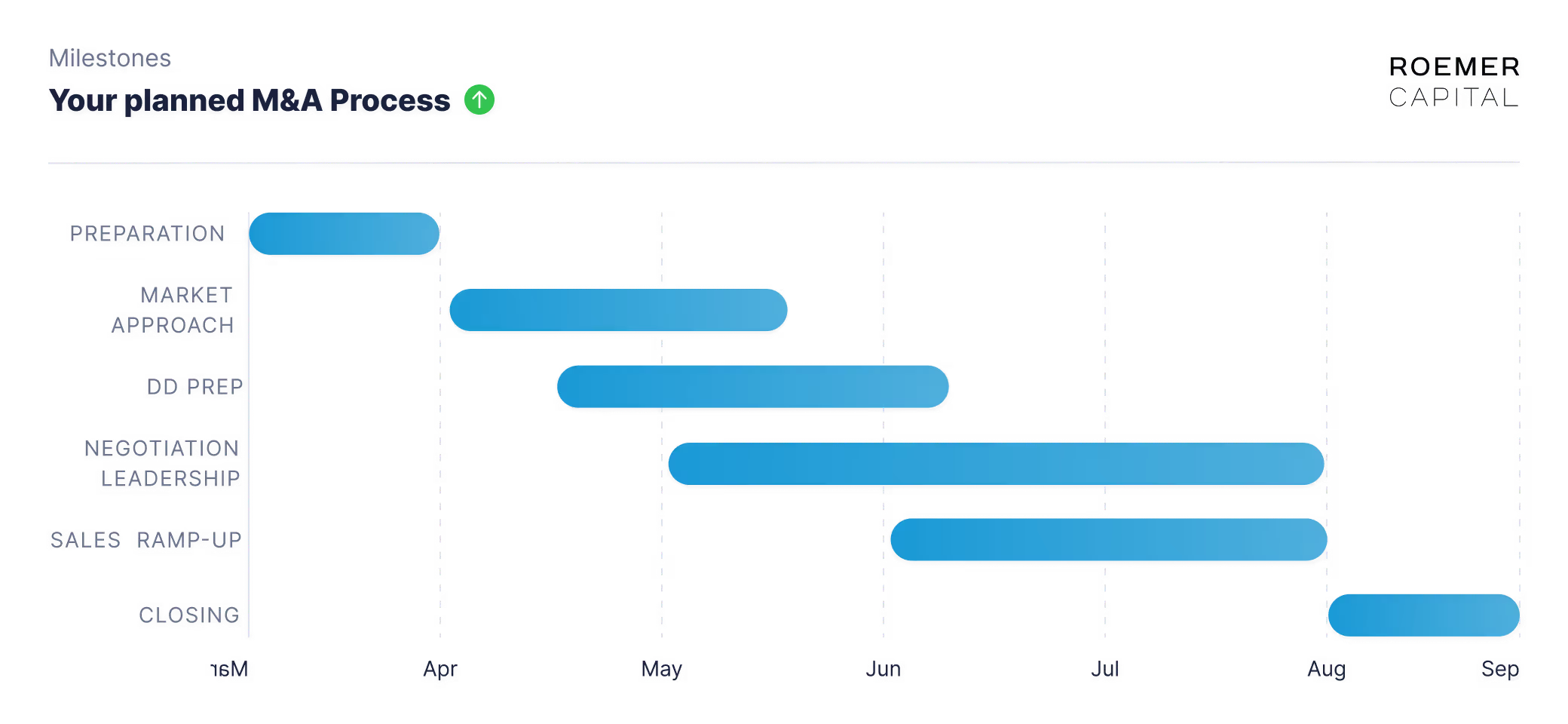
- From preparing the documents to closing usually takes six to twelve months. Preparation sets the pace.
- Costs arise for the M&A advisor, lawyers, tax advisor and, for GmbH shares, the notary. Tax is usually the largest deduction.
- In the worked example, an enterprise value of 10.5 million euro leaves the founder with about 6.6 million euro after costs and tax.
- Privately held GmbH shares of 1 percent or more are 60 percent taxable under section 17 EStG. In a holding GmbH, 95 percent of the gain is exempt under section 8b KStG.
Selling a company in Germany runs in three phases: preparation, confidential approach to buyers, and negotiation through to closing. From the moment you start preparing the documents to the day the money arrives, a structured sale usually takes six to twelve months. You pay for an M&A advisor, a law firm, a tax advisor and, for shares in a German GmbH, a notary, but the biggest deduction from your proceeds is usually tax.
This guide walks you through the process in nine steps, explains what drives the timeline and the costs, and works through one example from enterprise value to the cash you keep. It is written for founders and shareholders of German companies, including those who are based abroad.
How does the sale of a company work?
A structured sale follows almost the same order every time. The steps overlap, but skipping one usually costs you money later.
- Decide what you want. All of the company or a stake? Do you want to stay on after the sale, and for how long? Your answers decide which buyers fit.
- Check structure and tax. With your tax advisor you clarify who holds the shares, whether a share deal or an asset deal is realistic, and which holding periods are running. Do this first, because some changes need years of lead time.
- Prepare numbers and documents. Buyers expect several years of annual accounts, current monthly figures, a business plan and an adjusted EBITDA, meaning earnings before interest, tax, depreciation and amortisation without exceptional items and private costs. Add your key contracts, a current shareholder list and an organised data room.
- Estimate the value. Earnings, growth and comparable deals give you a valuation range. It is your yardstick for the offers, not a fixed price.
- Build the buyer list. A long list collects every plausible buyer: competitors, customers, suppliers, private equity funds, family offices and your own management. A short list narrows it down to the names you actually contact.
- Approach buyers confidentially. Interested parties first receive an anonymous teaser. Those who want more sign a confidentiality agreement and receive the information memorandum with business model, figures and plan.
- Compare offers and sign an LOI. After indicative offers and management presentations you pick one buyer and sign a letter of intent. It records the price and the key terms and usually grants the buyer exclusivity.
- Run the due diligence. The buyer reviews finance, tax, contracts, people and technology. At the same time the lawyers negotiate the purchase agreement.
- Signing and closing. Shares in a GmbH are sold and transferred in front of a German notary. At closing the purchase price is paid and the notary files the new shareholder list with the commercial register.
For each phase in detail, including the information memorandum, the bidding process and a sample timeline, read our guide to the M&A process. If you only want to sell part of your shares, read selling GmbH shares in Germany.
How long does it take to sell a company?
Six to twelve months is the usual range, counted from preparing the documents to closing. The difference rarely comes from the sale process itself. It comes from preparation. If you start with clean numbers, tidy contracts and a ready data room, you end up at the short end.
- Preparation: numbers, valuation, teaser, information memorandum and data room. Missing accounts or an outdated shareholder list make this the longest phase.
- Approach and offers: buyers need time for their investment committees. Running several buyers in parallel costs little extra time and strengthens your position.
- Exclusivity and due diligence: in a company sale the review tends to take six to twelve weeks. Exclusivity under the LOI often runs for a similar period.
- Signing to closing: without open conditions both happen on the same day. If the deal needs merger control clearance from the German Federal Cartel Office, it may only close after clearance (section 41 of the German Act against Restraints of Competition, GWB). Phase one takes one month, an extended second phase up to five months from complete filing (section 40 GWB).
Before the formal process there is often a longer phase that no timeline shows: making the company less dependent on you, building a second management layer and getting the numbers to buyer standard. That takes years rather than months. Our guide to exit strategy for founders shows how to plan it.
What does it cost to sell a company?
Costs arise in four places. There is no fixed total, because each item depends on different drivers.
M&A advisor
Transaction advisors usually charge a fixed retainer for the ongoing work plus a success fee that is only due if the sale happens. The success fee is normally a percentage of the price, sometimes with a minimum or a sliding scale. Four points often move the real amount more than the rate itself:
- the basis, enterprise value or the price for the shares,
- whether and when the fee applies to escrow, earnout or vendor loan,
- whether the retainer is credited against the success fee,
- how long a tail period applies if the sale closes after the mandate ends.
German VAT is added to the fee. If you sell shares as a private individual, you normally cannot reclaim it. Compare proposals on the total fee at the price you expect.
Law firm
The lawyers draft or review the purchase agreement, negotiate warranties and liability and prepare the notarisation. Cost depends on the length of the contract, the number of negotiation rounds and specialist questions such as employment law or merger control. Billing is usually by the hour or as an agreed fixed fee. German lawyers may only agree success fees in narrow exceptions (section 49b (2) of the Federal Lawyers' Act, BRAO).
Tax advisor
The tax advisor reviews the structure before the sale, calculates the tax for each option and covers the tax clauses in the contract. The effort depends on how clean the bookkeeping is and on whether the structure still needs to change.
Notary
Shares in a GmbH can only be sold and transferred by notarial deed (section 15 (3) and (4) of the German Limited Liability Companies Act, GmbHG). Notary fees are set by law in the Court and Notary Fees Act (GNotKG). They depend on the transaction value, for a share deal essentially the purchase price, and rise more slowly than the value. The contract decides who pays; often it is the buyer.
Other costs
- Data room: a licence for a virtual data room for the duration of the process.
- Vendor due diligence: a review commissioned by the seller before launch. It costs money but often saves time and arguments about the numbers.
- Warranty and indemnity insurance: it covers claims under the warranties and comes up when both sides want to cap the seller's liability.
- Your own time: a sale ties up management for months. If the numbers slip, that costs more than any fee.
For tax purposes the costs reduce your capital gain. For privately held shares they count as costs of sale under section 17 (2) of the German Income Tax Act (EStG), but under the partial income method only 60 percent are deductible (section 3c (2) EStG).
When an M&A advisor is not worth it
Not every sale needs a transaction advisor. If the buyer is already known, the price has been agreed at arm's length and only the contract is left, a law firm and a tax advisor are often enough. A handover to managers who have been with you for years and have secured financing is a typical case. For very small businesses the fee and the possible price uplift are often out of proportion; succession exchanges and the chambers of commerce can help there. An advisor pays off when several buyers should compete, when the value is hard to judge, or when you cannot leave the business to run itself for months.
What is my company worth?
Buyers derive the price from sustainable earnings. For profitable companies that is usually adjusted EBITDA multiplied by the factor at which comparable companies were sold. For growing technology companies without stable earnings, buyers often apply revenue multiples, especially to recurring revenue.
Keep two numbers apart. Enterprise value is the value of the operating business. Equity value, the price for your shares, is what reaches you: enterprise value minus financial debt plus surplus cash. Methods, multiples and common valuation mistakes are covered in our guide to company valuation. For a first range, try the valuation calculator.
Worked example: from enterprise value to net proceeds
A software GmbH is owned 100 percent by its founder, who holds the shares privately. Her acquisition cost equals the share capital of 25,000 euro. All figures are assumptions for the example.
- Reported EBITDA: 1,350,000 euro.
- Adjustments: the founder pays herself 120,000 euro, a hired managing director would cost 200,000 euro, so earnings go down by 80,000 euro. An exceptional lawsuit cost 230,000 euro, which is added back. Adjusted EBITDA: 1,350,000 minus 80,000 plus 230,000 equals 1,500,000 euro.
- Enterprise value at a multiple of 7.0: 1,500,000 × 7.0 equals 10,500,000 euro.
- Net financial debt: bank loans of 1,800,000 euro minus cash of 800,000 euro equals 1,000,000 euro.
- Price for the shares: 10,500,000 minus 1,000,000 equals 9,500,000 euro.
- Transaction costs for advisor, lawyers, tax advisor and notary combined: 250,000 euro.
- Capital gain: 9,500,000 minus 25,000 minus 250,000 equals 9,225,000 euro.
- Taxable under the partial income method: 60 percent of 9,225,000 equals 5,535,000 euro.
- Income tax, simplified at the top rate of 45 percent (section 32a EStG) plus the 5.5 percent solidarity surcharge on it, together 47.475 percent, no church tax: 5,535,000 × 47.475 percent equals 2,627,741 euro (rounded).
- Net proceeds: 9,500,000 minus 250,000 minus 2,627,741 equals 6,622,259 euro.
Out of an enterprise value of 10.5 million euro, the founder keeps about 6.6 million euro, a little over 63 percent. Tax is by far the largest deduction.
The example shows two levers. First, every adjustment counts seven times: if a 100,000 euro adjustment fails in due diligence, enterprise value falls by 700,000 euro. Second, it matters who holds the shares. Had the founder held them through her own holding GmbH, 95 percent of the gain would be tax exempt under section 8b of the German Corporate Income Tax Act (KStG). Assuming 30 percent corporate and trade tax on the remaining 5 percent, the tax would be 138,375 euro. The money would stay in the holding, though, and a holding set up shortly before the sale does not deliver this benefit as easily (see below).
Share deal or asset deal?
With a GmbH you normally sell your shares, which is a share deal. The company keeps all contracts, employees and risks, only the owner changes. In an asset deal the company itself sells its assets, contracts and operations. Buyers like it because they leave old risks behind and can depreciate the price. For sellers it is usually more expensive: the gain is first taxed in full inside the GmbH, and paying it out to you triggers tax a second time. A sole proprietorship has no shares, so its assets are always transferred individually. The transfer of a business as a whole is not subject to VAT (section 1 (1a) of the German VAT Act, UStG).
How is the sale of a German company taxed?
- Privately held GmbH shares of 1 percent or more: if you held at least 1 percent at any time in the last five years, section 17 EStG applies. Under the partial income method 40 percent of the gain is tax exempt (section 3 no. 40 EStG) and 60 percent is taxed at your personal rate. At the top rate including solidarity surcharge that is an effective burden of just under 28.5 percent of the gain.
- Privately held GmbH shares below 1 percent: the gain is investment income and subject to the 25 percent flat tax (section 32d (1) EStG) plus solidarity surcharge.
- Shares held by a holding GmbH: the gain is tax exempt under section 8b (2) KStG, but 5 percent count as expenses that cannot be deducted (section 8b (3) KStG). The burden is around 1.5 percent of the gain (as of 2026). If the holding is created shortly before the sale by contributing the shares, a lock up period of seven years applies. A sale within that period triggers retroactive tax, which falls by one seventh for each full year that has passed (section 22 (2) of the German Reorganisation Tax Act, UmwStG).
- Sole proprietorships and partnership interests: the rules on the sale of a business apply (section 16 EStG). Subject to personal conditions, for example from age 55, there is an allowance on application (section 16 (4) EStG) and a reduced tax rate (section 34 (3) EStG). Both are granted only once in a lifetime.
Tax residence matters too. If you live outside Germany, Germany may still tax a gain on shares in a German GmbH (section 49 (1) no. 2 (e) EStG); whether it actually can depends largely on the double tax treaty with your country of residence. Clarify which case applies to you with a German tax advisor before you talk to buyers.
Who buys companies?
- Strategic buyers: competitors, customers or suppliers. They often pay the most because they can realise synergies, but they get a deep look at your numbers and customers.
- Private equity funds: they buy to develop the company and sell it again after several years. They often ask you to reinvest part of your proceeds.
- Family offices: they manage family wealth and tend to hold investments longer than funds.
- Your own management: in a management buyout the leadership team takes over. The price is often lower because financing caps it, but the sale stays discreet.
If the sale is part of your succession, read our guide to business succession in Germany. It compares a sale, a family handover and a management buyout with numbers.
How is the purchase price paid?
Not all of the price is always paid at closing. Three elements are common:
- Escrow: part of the price sits in an escrow account for a period as security for the buyer's warranty claims.
- Earnout: part of the price depends on the company hitting agreed targets after the sale, often over one to three financial years. Value it at its expected, discounted amount, not at the maximum.
- Vendor loan: you defer part of the price, usually ranking behind the bank. In practice that is often 10 to 30 percent of the price.
So when you compare two offers, the headline number matters less than what reaches you, when, and how secure it is.
Common mistakes when selling a company
- Starting too late. If you only plan once you want out, you sell with every weakness intact. Owner dependence and thin numbers cannot be fixed in three months.
- Talking to one buyer only. Without competition you have no benchmark for price and terms, and the buyer knows it.
- Adjustments that do not hold. Every item in adjusted EBITDA needs evidence. If it fails in due diligence, it costs a multiple of its amount.
- Looking only at the price. Warranties, liability caps, escrow and earnout often decide your result as much as the number in the LOI.
- Leaving tax too late. A holding set up just before the sale helps little and can trigger retroactive tax.
- Missing change of control clauses. Some contracts let the other party terminate when the owner changes. If the buyer finds them in due diligence, they become a reason for a price cut.
- Neglecting the business. If revenue or earnings drop during the process, the buyer will renegotiate.
Frequently asked questions
How long does it take to sell a company in Germany?
Usually six to twelve months from preparing the documents to closing. Good preparation shortens it; missing numbers or a merger control filing make it longer.
How much does it cost to sell a company?
There is no flat amount. Advisor fees depend on price and effort, notary fees on the transaction value under the GNotKG, and legal and tax fees on the scope of work. The largest deduction from your proceeds is usually tax.
Can I sell my company tax free?
Almost never completely. Privately held GmbH shares of 1 percent or more are 60 percent taxable. In a holding GmbH 95 percent of the gain is exempt as long as the money stays there, but a holding created shortly before the sale triggers partial retroactive tax within seven years.
Do I need a notary to sell my company?
For shares in a GmbH, yes. Both the purchase agreement and the transfer must be notarised (section 15 (3) and (4) GmbHG). The buyer only counts as a shareholder towards the company once listed in the shareholder list filed with the commercial register (section 16 (1) GmbHG). If you cannot attend in person, an authorised representative can sign for you; notaries usually ask for a written, often certified power of attorney.
Do my employees have to be informed?
In a share deal nothing changes for employees legally; their contracts simply continue. If a business or part of a business passes in an asset deal, the employment relationships transfer to the buyer and every affected employee must be informed in text form beforehand (section 613a of the German Civil Code, BGB).
Can I stay with the company after the sale?
Yes, usually for a limited time. Buyers often agree a transition period in which you hand over customers and knowledge, as managing director or as an advisor. If an earnout depends on you staying, have the tax treatment checked, because the payment may then be treated as salary.
When is the best time to sell?
When the company is growing and the numbers are stable, not during a standstill. Buyers pay for the future. If you sell after two weak quarters, you will have to explain the dip and you will get less.
How Roemer Capital helps
Roemer Capital is an independent fundraising and M&A boutique based in Düsseldorf. We support founders and shareholders of technology companies with a product on the market and existing revenue through the whole sale: valuation, teaser and buyer list, data room and due diligence, through to LOI, signing and closing. A sale usually takes six to twelve months with us, and we generally work towards six. The purchase agreement and tax structuring stay with your lawyers and tax advisor, and we work closely with both.
Our fee is a monthly retainer plus a success fee that is only due if the sale happens and is based on the price achieved. Read more about our M&A advisory for company sales, or book an intro call to talk through your situation.
Note
As of October 2026. This article is not legal or tax advice.
FAQs
Here you can find the important questions.