How to Find Investors: Types, Approach and Timeline


Whether you're refining your pitch, planning your fundraising strategy, or scaling your business: we're here to help.






- Fit beats volume: stage, cheque size and sector must match before you contact the first investor.
- Angels and seed funds suit early stages, VC funds, corporate VC and family offices fit Series A to C, private equity fits profitable companies. Development banks complement.
- A round usually takes 6 to 8 months. Start while you still have 12 to 18 months of runway.
- Build a longlist of often more than 100 names, reach the best fits through warm introductions and talk to investors in parallel.
- Prepare a teaser of five slides at most, a pitch deck of 15 to 20 slides and a financial model with three cases over at least three years.
To find the right investors, work through five steps: pin down how much capital you need and which stage you are at, build a longlist of often more than 100 investors filtered by stage, cheque size and sector, reach the best fits through warm introductions, back the approach with a teaser, a pitch deck and a financial model, and run every conversation within one tight window. A funding round usually takes 6 to 8 months, so start while your cash still covers 12 to 18 months.
This guide explains which investors suit which stage, how to build and work the list, what documents you need, how long it takes and when you can do it without an adviser.
Which investors fit which stage?
Many rejections have nothing to do with the quality of your company. The investor simply does not match your stage, round size or sector. A fund that only leads rounds of 10 million euro and more will not back a seed round, however good it is. These are the investor types to know.
Business angels
Business angels are private individuals investing their own money, often former founders or executives. They come in early, decide quickly and bring experience and contacts. Their cheques are smaller than those of funds. In Germany, angels who buy new shares in young, innovative companies can, under certain conditions, receive a government grant from the INVEST programme run by the Federal Office for Economic Affairs and Export Control (BAFA). That can be a useful point when you approach German angels. Check with BAFA beforehand whether the programme is currently open and on what terms.
Family offices
Family offices manage the wealth of an entrepreneurial family. Some invest like angels, others like growth funds or private equity. Many have no fixed fund term, so they can afford to wait longer for a return. They pay closer attention to substance, cash flow and governance. The hard part is access, because many family offices keep a very low public profile.
Venture capital funds
VC funds invest money from their own investors out of a fund with a fixed term, often around ten years. They make new investments only in the first years of that term and afterwards mostly support their existing portfolio. They look for companies that can grow fast and be sold later. There are seed funds, Series A and B funds and growth funds for later rounds. Roles matter: the lead investor drives the round and negotiates the terms, while other funds follow.
Corporate venture capital
Corporate VC units are the investment arms of large companies. Besides money they often bring access to customers, distribution or technology, and in return they pursue strategic goals of their own. Watch out for information rights, rights of first refusal and the signal you send: once one group holds a stake, its competitors may hesitate to bid for you later.
Private equity
Private equity firms mostly buy majority stakes in mature, profitable companies and fund part of the purchase with debt. Some also take minority stakes in profitable growth companies. They are rarely the right address for a startup without profit, but often a good fit for an established company with stable earnings.
Development banks
In Germany, KfW, the federal development bank, and the promotional banks of the federal states mainly provide subsidised loans, which you usually apply for through your own bank. There are also public investment companies and funds backed by public money that take equity stakes directly, often alongside private investors. Public money complements a round well, but it rarely replaces a private lead investor.
Roughly, the types map to stages like this:
- Idea to first customers: business angels, founder grants and public programmes
- First revenue (seed): business angels, seed funds, public investment companies
- Scaling revenue (Series A to C): VC funds, corporate VC, family offices, growth funds
- Profitable and established: private equity, family offices, with development loans on top
What each type wants to see in your materials is covered in our article on investor types for tech startups.
How much should you raise, and when should you start?
Before you contact the first investor, you need two numbers: how long your cash lasts and how big the round should be. Here is a worked example. A software company has 2.4 million euro in the bank and a net burn of 200,000 euro a month.
- Runway today: 2.4 million divided by 200,000 equals 12 months.
- The round takes 6 to 8 months. If the team starts now, 4 months of cash are left after 8 months, which is 800,000 euro.
- The plan for the 24 months after the round adds sales capacity. Average burn rises to 300,000 euro a month, 7.2 million euro in total.
- The remaining cash covers 0.8 million euro of that. The gap is 6.4 million euro.
- With a 10 percent reserve that comes to 7.04 million euro, so a round of about 7 million euro.
If the team waits three months, only one month of cash is left at the end of an 8 month process. Every investor will notice, and your negotiating position suffers. The rule is simple: start while you still have 12 to 18 months of runway.
Round size and valuation go together. At a pre money valuation of 21 million euro, investors putting in 7 million euro hold 25 percent afterwards (7 divided by 28). How investors arrive at that valuation is explained in our guide to company valuation methods. To see whether your numbers work from an investor's point of view, take the fundability check, which takes a few minutes.
Where do you find investors? Building a longlist
The longlist is the list of every investor that could plausibly join your round. It is your most important working document and it stays internal. This is how to build it:
- Define the profile: stage, round size, the cheque you need from a lead, sector, business model and region.
- Work the sources: investor databases, announced rounds of comparable companies, shareholder lists of similar companies in the commercial register, your own network and that of your existing investors.
- Record the essentials for each name: type, focus, typical cheque, age of the current fund, competitors in the portfolio, the right contact, a possible route to an introduction, and the source with a date.
- Apply a rough filter: remove anyone whose cheque size does not fit, who does not invest in your sector, whose fund has no money left for new deals or who backs a direct competitor.
- Prioritise: sort the rest into A, B and C by fit and access. Keep a separate exclusion list of names you deliberately leave out, such as competitors.
A simple calculation with assumed rates shows why the list has to be long. From 150 names, 70 remain after filtering. If 30 percent of them reply, you hold 21 first meetings. Six investors dig deeper, and in the end one or two term sheets arrive. These rates are assumptions for the example, not statistics, but they show why 20 names are rarely enough.
How do you approach investors?
Ideally through a warm introduction from someone the investor trusts. An email that reaches a partner from a founder in the portfolio, a co investor or a business angel gets read. A cold email to a general inbox often does not.
- Find the route: for every A name, check who in your network knows the investor. Existing investors, founders from the fund's portfolio, lawyers and advisers open the most doors.
- Write a forwardable email: three to five sentences on the company, key figures and round size, with the teaser attached, so your contact can simply pass it on.
- Go direct when there is no route: write to the responsible partner personally and say in one sentence why you fit their portfolio.
- Work in waves: start with a few B names to sharpen your pitch, then approach all A names within a few weeks so that offers arrive at the same time.
- Follow up and keep track: after about a week without a reply, follow up once, politely. Log every contact and next step in one list.
The single most important point is parallel, not sequential. Only when several investors are looking at the same time does real competition for your round emerge.
What documents do investors expect?
- Teaser: five slides at most, or one to two pages. What you do, for whom, the key figures, the round size and a contact. It goes out with the first email.
- Pitch deck: 15 to 20 slides covering problem, solution, market, business model, traction, competition, team, financials, use of funds and round structure.
- Financial model: at least three years with a base case, a downside case and an upside case. Assumptions are visible so an investor can change them.
- Cap table: current holdings, the option pool and the planned round on a fully diluted basis.
- Data room: contracts, annual accounts, monthly figures and HR documents for due diligence. It should be ready before the first term sheet arrives.
Many funds will not sign a non disclosure agreement just to read a pitch deck, because they see a very large number of companies. Leave anything out of the deck that must not get out. Sensitive details belong in the data room later.
How long does it take to find investors?
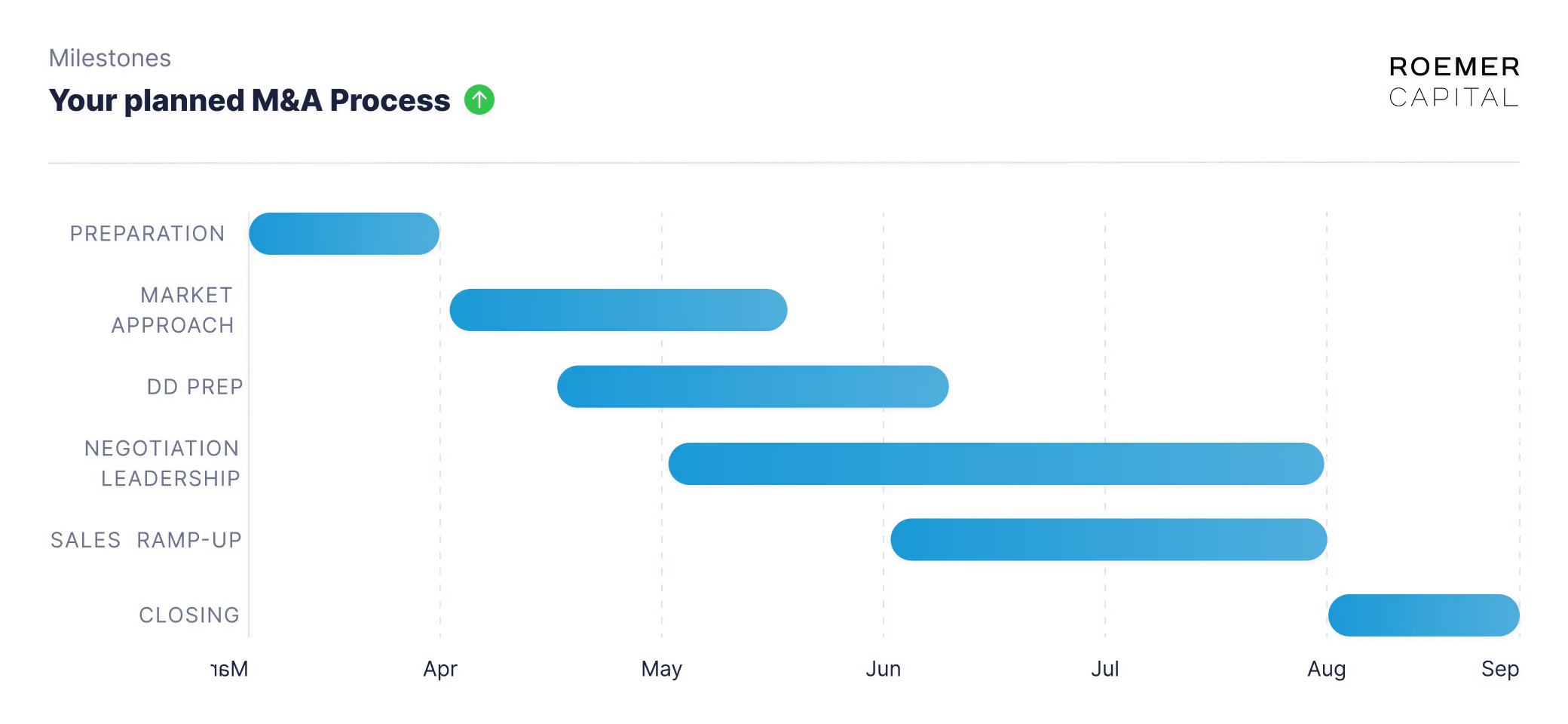
From the start of preparation to closing, a funding round usually takes 6 to 8 months. A typical sequence:
- Preparing documents, financial model and longlist: 6 to 8 weeks
- Outreach and first meetings: 6 to 8 weeks
- Deeper talks up to a term sheet: 6 to 8 weeks
- Due diligence, contracts and notary appointment: 8 to 10 weeks
That adds up to 26 to 34 weeks. For a German GmbH, the shareholder resolution on the capital increase must be notarised (section 53 (2) GmbHG), and the increase only takes effect once it is entered in the commercial register (section 54 (3) GmbHG). Build both steps into your timeline from day one.
Do you need an adviser to find investors?
Not always. You can often manage without one if any of these apply:
- The round is below 1 million euro and mainly angels from your own network are investing.
- An existing investor leads the round and the terms are already agreed.
- You already hold a term sheet. At that point you mainly need an experienced lawyer for the contracts.
- Someone on your team has run rounds before and has the time to do it again.
An adviser is more likely to pay off when you raise 1 million euro or more from institutional investors, your network into those investors is thin, day to day business must not suffer during the process, or you want several offers competing. Ask any adviser how many relevant investors they know directly, which comparable rounds they have run, who will actually do the work and how their fee is structured.
Common mistakes
- Starting too late: with less than six months of runway you negotiate under time pressure, and investors know it.
- Spray and pray: hundreds of unfiltered cold emails waste time and burn names you may need later.
- Wrong cheque size: a fund that only starts at 10 million euro will not lead a 2 million euro round.
- One after another: if you approach investors one by one, you never have two offers at once.
- Half finished materials: contradictions between pitch deck and financial model cost more trust than cautious numbers.
- Only looking at valuation: liquidation preferences, anti dilution protection and consent rights also decide what you end up owning.
- Granting exclusivity too early: once you give one investor exclusivity before other offers exist, your leverage is gone.
Frequently asked questions
Where can I find private investors?
Private investors, meaning business angels, are mostly found through referrals: founders who have raised money themselves, angel networks, industry events and your existing investors. Many angels invest in markets they have worked in, so look specifically for people with experience in your sector.
How many investors should I contact?
For a round with institutional investors, a filtered list of 50 to 100 well matched names is a good size. Fit matters more than volume. Sixty investors whose stage, cheque size and sector match beat 300 unfiltered ones.
What is a lead investor?
The lead investor drives the round. They usually put in the largest amount, negotiate the valuation and term sheet, and run the most thorough review. Other investors often only commit once a lead is in place, so find your lead first.
Can I find investors for a business idea?
It is possible, but hard. At the idea stage your options are mainly business angels, founder grants and public programmes. Institutional investors usually want to see a product in the market and the first paying customers.
How much equity do I give up in a round?
New investors receive their investment divided by the post money valuation. Putting 2 million euro in at a pre money valuation of 8 million euro buys 20 percent (2 divided by 10). All existing shareholders are diluted in the same proportion, and a new option pool dilutes further.
What does it cost to raise with an adviser?
Many advisers charge a monthly retainer plus a success fee tied to closing the round. The amount depends on round size and effort. Get the fee structure in writing before you start and run the numbers for your own round size.
How Roemer Capital helps
Roemer Capital is an independent fundraising and M&A boutique based in Düsseldorf. We work with technology companies that have a product in the market and ongoing revenue on funding rounds from 1 million euro, typically Series A to C. Our network covers more than 1,000 contacts at more than 400 investment firms. We build the longlist, teaser, pitch deck and financial model with you, run the outreach and support the negotiation through to the notary appointment. We plan a round over 6 to 8 months.
Our fee is a monthly retainer plus a success fee. If your round is below 1 million euro or an existing investor is already leading it, you probably do not need us. If what you mainly need is someone to build the financial model and run reporting, a fractional CFO may be the better fit. To talk through your round, book an intro call.
Note
As of October 2026. This article does not replace legal or tax advice.
FAQs
Here you can find the important questions.